Geotextile membranes (also called geotextile fabrics or geo fabrics) are permeable synthetic materials essential for separation, filtration, drainage, reinforcement, and protection in civil engineering, road construction, environmental projects, and landscaping. These fabrics allow water to pass while retaining soil particles, prevent mixing of different soil layers, and improve the long-term stability of structures. One of the most common questions from engineers, contractors, project managers, and procurement specialists is: What is the geotextile membrane cost per m²?
In 2026, the material cost of geotextile membranes typically ranges from $0.15 to $2.50 per square meter for standard nonwoven products, with heavier or high-strength woven grades reaching $0.50 to $3.50 per square meter or higher. Installed costs can increase total project expenditure by 20–50% depending on site conditions and labor. This comprehensive guide systematically analyzes geotextile membrane pricing on a per-square-meter basis from a manufacturer’s perspective. Whether you are specifying fabric for a small drainage trench or a large highway project, the following sections provide detailed specifications, cost breakdowns, and practical advice. For accurate project quotations, contact The Best Project Material Co., Ltd. (BPM Geosynthetics).
1. What Are Geotextile Membranes?
Geotextile membranes are permeable geosynthetic fabrics manufactured primarily from polypropylene (PP) or polyester (PET) fibers. They are produced as nonwoven (needle-punched or thermally bonded) or woven structures and are designed to interact with soil and water in engineered applications.
Common applications include:
- Road and Railway Construction: Separation of subgrade from aggregate base and filtration under pavements to prevent pumping and contamination.
- Drainage Systems: French drains, trench drains, and underdrains where the fabric allows water passage while retaining soil particles.
- Landfills and Environmental Containment: Filtration layers in leachate collection systems and protection of geomembranes.
- Erosion Control and Slope Protection: Stabilization of embankments and shoreline protection.
- Retaining Walls and MSE Structures: Drainage and separation behind walls.
- Landscaping and Agriculture: Weed barriers, soil stabilization, and temporary erosion control.
Key technical specifications typically include:
- Mass per unit area: 100–800 g/m²
- Apparent opening size (AOS/O90): 0.07–0.30 mm
- Water flow rate / permittivity: high values supporting rapid drainage (often 80–250 L/m²/s or higher)
- Tensile strength: 5–100+ kN/m depending on type and weight
- CBR puncture resistance: 300–6,000+ N
- Elongation: 15–100% (higher for nonwovens)
- Design life: 20–50+ years in buried conditions when properly selected and installed
These properties make geotextile membranes critical for long-term performance, but their cost per square meter is influenced by multiple technical and commercial factors explored below.
2. How Much Does a Geotextile Membrane Cost per m²?
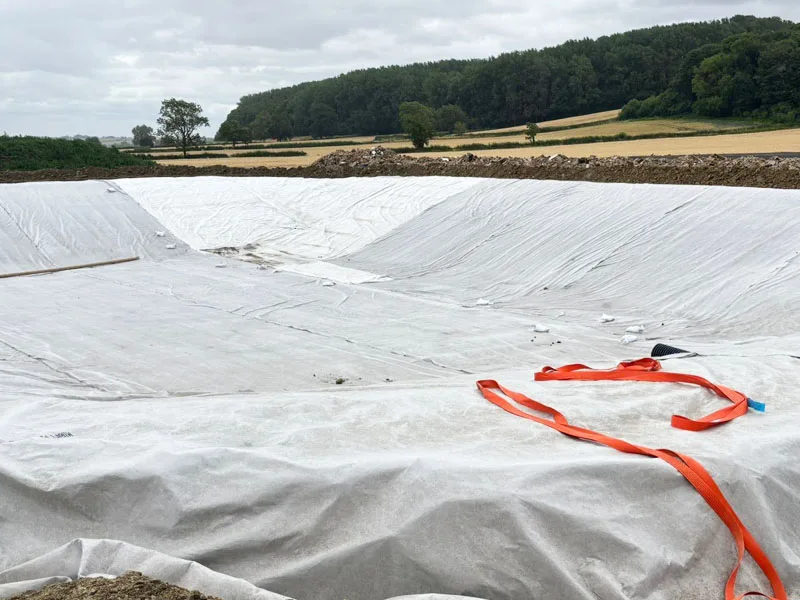
The material cost of a geotextile membrane typically ranges from $0.15 to $2.50 per square meter for standard nonwoven grades, excluding installation and additional services. Lightweight fabrics for landscaping or light filtration may cost as little as $0.15–$0.50/m², while heavy-duty or high-strength woven fabrics can reach $1.00–$3.50/m². Installation, transportation, and site preparation can add 20–50% to the total project cost. Below we break down the key factors influencing geotextile membrane cost per square meter, supported by current industry data.
2.1 Geotextile Membrane Cost per m² – Type of Fabric
The manufacturing structure is one of the strongest price drivers.
2.1.1 Non-Woven Geotextile Membranes
- Cost: $0.15 – $2.00 per square meter
- Properties: High permeability, excellent filtration, good conformability, and elongation typically 40–100%
- Applications: Drainage, filtration, separation, and protection layers
- Advantage: Most cost-effective for hydraulic functions; accounts for the majority of filtration applications
- Example: Standard 150–300 g/m² polypropylene nonwoven often ranges from $0.25–$0.90/m² in bulk orders from manufacturers such as BPM Geosynthetics
2.1.2 Woven Geotextile Membranes
- Cost: $0.30 – $3.50 per square meter
- Properties: Higher tensile strength (often 20–100+ kN/m), lower elongation, and greater dimensional stability
- Applications: Soil reinforcement, separation under heavy loads, and stabilization
- Advantage: Superior strength for structural roles; generally more expensive than equivalent nonwoven grades
Nonwoven fabrics dominate filtration and drainage projects due to better cost-performance balance for those functions.
2.2 Geotextile Membrane Cost per m² – Material Composition
Polymer choice affects both performance and unit price.
2.2.1 Polypropylene (PP)
- Cost: $0.15 – $2.00 per square meter for most nonwoven grades
- Properties: Excellent chemical resistance (stable in pH 2–13), good UV resistance when stabilized, and favorable cost-to-weight ratio
- Market Position: Dominant material for the majority of filter and separation applications
- Advantage: Most economical high-performance option for permanent buried use
2.2.2 Polyester (PET)
- Cost: $0.40 – $3.00+ per square meter
- Properties: Higher tensile strength and better creep resistance in certain conditions
- Applications: Heavier reinforcement or environments requiring elevated mechanical properties
- Advantage: Preferred where higher long-term strength is critical; typically 20–50% more expensive than comparable PP
Virgin fiber grades command a premium over recycled-content fabrics but deliver superior consistency and longevity.
2.3 Geotextile Membrane Cost per m² – Weight (Mass per Unit Area)
Weight is a primary cost driver because it directly correlates with fiber consumption and mechanical performance.
- Lightweight (100–200 g/m²): $0.15 – $0.60/m²
Suitable for landscaping, light drainage, weed control, and temporary applications. Example: 150 g/m² PP nonwoven commonly $0.25–$0.45/m² in volume. - Medium-weight (200–400 g/m²): $0.40 – $1.20/m²
Standard for road subgrade separation, underdrains, and general filtration. 300 g/m² grades frequently range from $0.50–$0.90/m². - Heavyweight (400–800 g/m²): $0.80 – $2.50+/m²
Used for high-survivability separation, geomembrane protection, and heavy-duty filtration. Prices increase with mass and required puncture resistance.
Each additional 50 g/m² typically raises the unit price by 15–25%.
2.4 Geotextile Membrane Cost per m² – Project Size and Scale
Economies of scale significantly influence the price per square meter:
- Small projects (<5,000 m²): Higher unit costs ($0.50 – $2.50/m²) due to setup, cutting, handling, and smaller production runs.
- Medium projects (5,000–50,000 m²): Moderate pricing with 5–15% volume discounts.
- Large projects (>50,000 m²): Lowest unit prices ($0.15 – $1.50/m²) and preferential logistics. Bulk discounts of 10–25% are common for container or full-truckload orders.
Custom widths or special packaging can add 10–15% to the base price.
2.5 Geotextile Membrane Cost per m² – Raw Material Quality
- Virgin fiber: Higher initial cost but superior uniformity, strength retention, chemical resistance, and service life (typically 20–50+ years buried). Recommended for permanent infrastructure.
- Recycled content: 15–30% lower price but reduced long-term performance and higher risk of degradation. Suitable mainly for temporary or non-critical uses.
High-quality virgin polypropylene or polyester significantly lowers lifetime maintenance and replacement costs. BPM Geosynthetics emphasizes virgin-fiber production for consistent performance in demanding applications.
2.6 Transportation and Logistics
Shipping large rolls adds to the delivered price per square meter:
- Distance and destination can increase costs by $0.05–$0.30/m² or more.
- Full-container or full-truckload shipments reduce unit logistics costs compared with less-than-truckload deliveries.
- Manufacturing locations with good port and highway access generally offer lower landed costs for international buyers.
2.7 Installation and Lifetime Costs
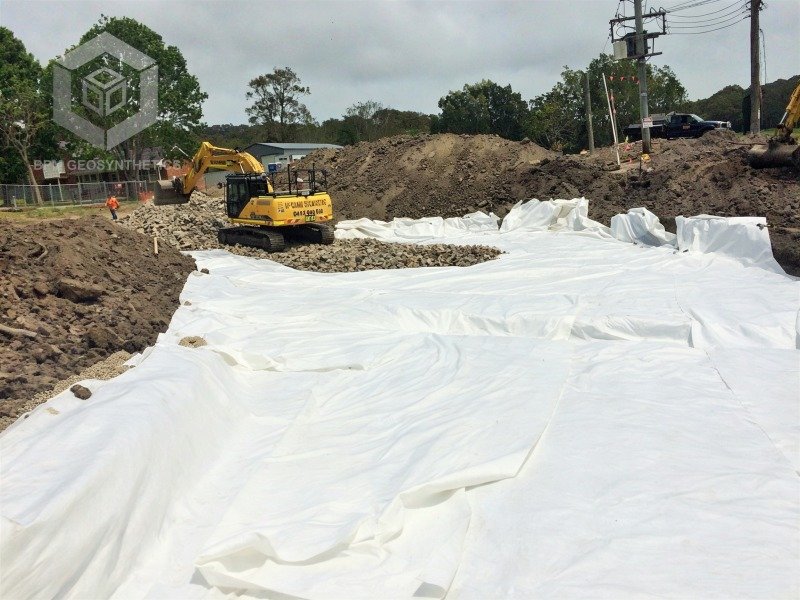
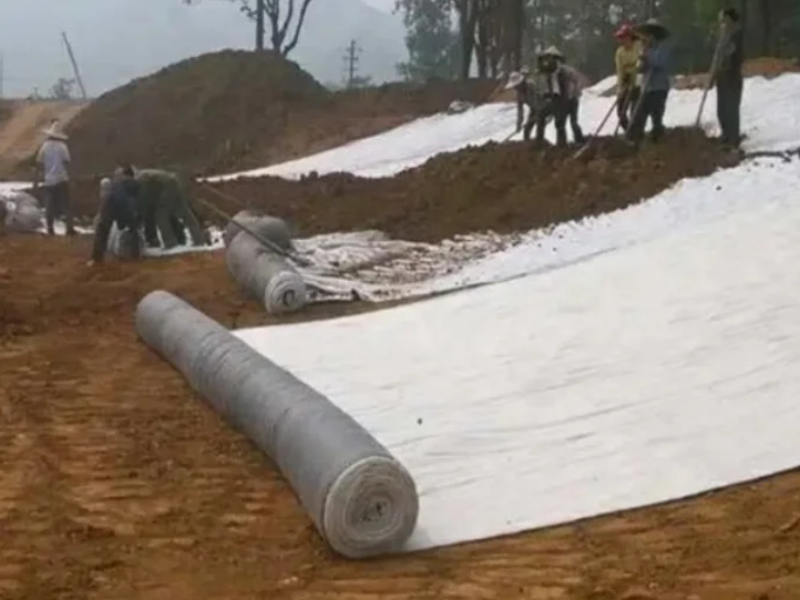
Installation typically accounts for 20–50% of total project cost. Proper overlap (commonly 300–600 mm), secure placement, and protection from construction traffic are essential. High-quality geotextile membrane requires minimal maintenance once installed and can provide decades of reliable service. Under-specified or low-quality fabric often leads to clogging, reduced drainage capacity, soil contamination, and expensive remediation.
3. How to Choose the Right Geotextile Membrane
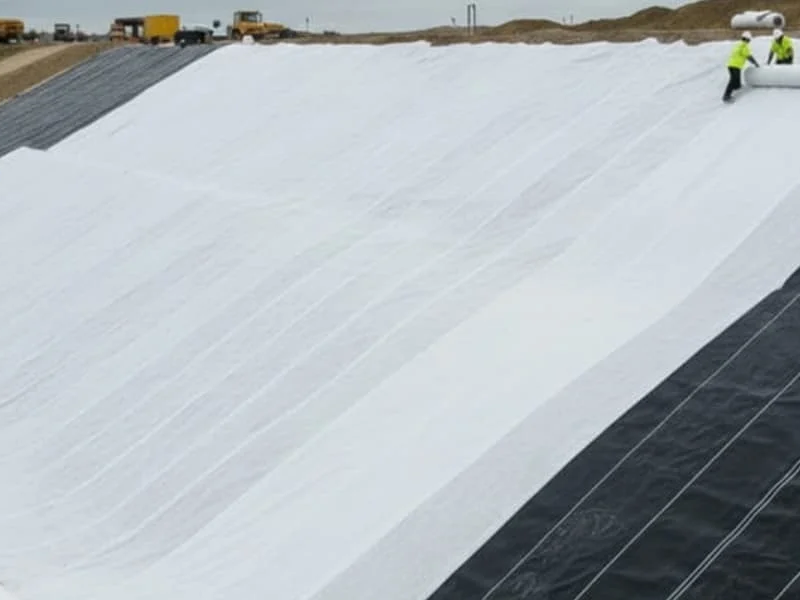
Selecting the appropriate geotextile membrane requires balancing hydraulic performance, mechanical survivability, and total cost of ownership:
3.1 Assess Project Requirements
Match fabric properties to the application:
- Light drainage and landscaping → 100–200 g/m² nonwoven
- Road subgrade filtration and separation → 200–400 g/m² nonwoven
- Heavy protection or high-survivability → 400–600+ g/m²
- Structural reinforcement → woven high-strength grades
3.2 Prioritize Quality
Choose virgin-fiber fabrics from reputable manufacturers such as The Best Project Material Co., Ltd. (BPM Geosynthetics) that can supply consistent laboratory data for mass, tensile strength, CBR puncture, permittivity, and apparent opening size (ASTM or ISO methods).
3.3 Evaluate Installation and Site Conditions
Ensure the fabric can withstand expected construction stresses. Higher puncture resistance reduces damage risk during aggregate placement.
3.4 Consider Long-Term Value
A modestly higher initial investment in the correct specification usually delivers lower lifetime cost through extended service life and reduced maintenance.
3.5 Compare Suppliers Thoroughly
Request full technical data sheets, samples, resin origin confirmation (virgin vs. recycled), and clear quotations that include tolerances and delivery terms. Compare total installed cost rather than unit material price alone.
4. Practical Cost Examples per Square Meter
- 5,000 m² of 150 g/m² PP nonwoven for French drains: approximately $1,250–$2,500 material cost ($0.25–$0.50/m²)
- 20,000 m² of 300 g/m² PP nonwoven for road separation: approximately $10,000–$18,000 material cost ($0.50–$0.90/m²)
- 50,000 m² of 400–500 g/m² heavy nonwoven for protection layers: volume pricing can reduce unit costs into the $0.80–$1.50/m² range
5. Conclusion
Geotextile membrane cost per m² in 2026 typically ranges from $0.15 to $2.50 for standard nonwoven material, with woven and heavy-duty grades commanding higher prices. The primary cost drivers are fabric type (nonwoven vs. woven), polymer (polypropylene vs. polyester), mass per unit area, virgin versus recycled content, order volume, and logistics. Nonwoven polypropylene fabrics offer the best balance of filtration performance and cost for the majority of drainage and separation applications.
Investing in the correct specification from a reliable manufacturer typically yields the lowest total cost of ownership by ensuring effective long-term filtration, separation, and structural performance. For detailed technical data sheets, samples, and competitive project quotations tailored to your requirements, contact The Best Project Material Co., Ltd. (BPM Geosynthetics). Their experienced team can assist with product selection and provide accurate per-square-meter pricing to support effective budgeting and successful project outcomes.