1. Introduction
For managers in charge of mining, landfill and industrial containment projects, geomembrane cost per square foot serves as a core budget indicator that balances initial investment and long-term environmental risk control. Low-cost geomembrane liners with inferior mechanical strength or chemical resistance often lead to frequent leakage repairs, regulatory penalties and early overall replacement, greatly increasing the total lifecycle cost of projects. This independent 2026 review evaluates eight mainstream geomembrane products, comprehensively sorting out their per-square-foot raw material costs, performance strengths, applicable scenarios and potential hidden cost risks. All price data is based on bulk container orders for engineering projects in North America, Southeast Asia and Australia, excluding additional expenses such as geotextile protection, welding labor and site preparation fees. By comparing the unit price, service life, puncture resistance and chemical tolerance of each liner, this guide helps contractors select the most cost-effective barrier material, rather than simply choosing the lowest upfront-priced option.
2. Key Factors That Determine Geomembrane Per-Square-Foot Cost
To accurately evaluate geomembrane cost performance, it is essential to master four core price-driving factors before product selection. Firstly, material thickness directly affects resin consumption: 2.0 mm HDPE geomembrane costs nearly 45% more per square foot than 1.0 mm smooth HDPE. Secondly, surface texture brings a 20–35% price premium for textured HDPE, due to its slower and more complex extrusion production process. Thirdly, virgin resin and high-grade antioxidant formulas raise unit prices significantly but extend the exposed service life of geomembranes by decades. Fourthly, special materials such as EPDM and bituminous composite geomembranes have higher manufacturing costs than conventional PVC or recycled HDPE products. In addition, order volume greatly impacts unit pricing: bulk orders over 100,000 square feet enjoy a 12–20% volume discount, while customized small-batch rolls for small-scale projects will substantially increase per-square-foot costs.
3. Detailed Review of 8 Geomembranes (Cost Per Square Foot & Performance)
3.1 Recycled Virgin-Blend HDPE Geomembrane
Blended with certified recycled polyethylene and a thin virgin top barrier layer, this geomembrane is the most cost-effective heavy-duty liner on the market. It complies with the basic GRI-GM13 standards, suitable for non-corrosive stormwater ponds and waste stockpile coverage projects. Its ultra-low per-square-foot cost makes it a preferred choice for mid-tier mining enterprises pursuing ESG carbon reduction goals. The main limitation is its reduced oxidative stability, which disqualifies it for acid heap leach pad applications, with a maximum exposed service life of 18 years. It is most suitable for large-area neutral wastewater retention lagoons with minimal chemical exposure.
3.2 Standard Rigid PVC Geomembrane
PVC geomembrane features the lowest entry cost for small-scale engineering scenarios, including sediment tanks and low-alkalinity workshop pits. Its lightweight roll design reduces per-square-foot shipping costs, and hot-air welding construction requires low-cost equipment and minimal crew training, further lowering construction thresholds. However, plasticizer degradation shortens its outdoor service life to 8–12 years, and concentrated cyanide or sulfuric acid can cause rapid material brittling. Despite its favorable upfront unit price, frequent replacement makes it uneconomical for permanent mining facilities.
3.3 UV-Stabilized Standard LLDPE Geomembrane
Lightweight modified LLDPE geomembrane balances moderate per-square-foot pricing and excellent freeze-thaw resistance, ideal for short-term mine process water lagoons. It can be quickly laid on rough, ungraded subgrades, effectively cutting labor overheads despite slightly higher material costs than PVC. Equipped with professional anti-UV additives, it supports 20 years of partial outdoor exposure. Its only drawback is weak acid resistance, making it unsuitable for heap leach projects. It is widely adopted in Canadian gold exploration projects to control short-cycle project budgets.
3.4 Smooth Reinforced LLDPE Geomembrane
With string reinforcement, this LLDPE geomembrane has a slight per-square-foot price increase compared with standard LLDPE, but it delivers over 700% elongation performance, adapting to frequent foundation settlement in desert lithium evaporation ponds. Added special salt-resistant additives prevent material degradation under hyper-saline brine environments, avoiding costly early liner repairs. A 1.2 million square foot lithium mine project in Chile has verified its outstanding long-term cost efficiency, proving its value despite higher upfront material costs.
3.5 Smooth Virgin HDPE Geomembrane
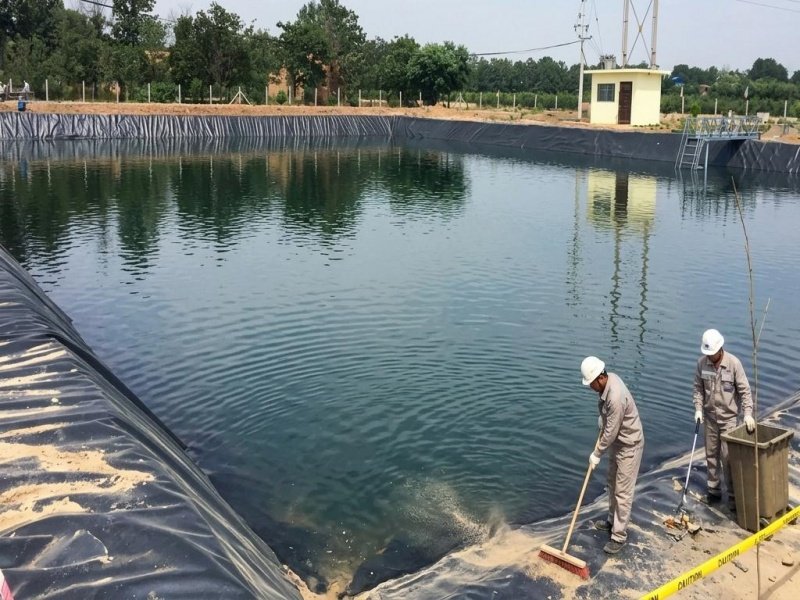
Virgin smooth HDPE is the most widely specified liner for landfills and standard tailings dams, with a balanced per-square-foot cost and full-spectrum chemical resistance (pH 1–13.5). Its high carbon black content guarantees a 30-year exposed service warranty, and excellent puncture strength eliminates frequent patch repair work. Brands like BPM Geosynthetics provide stable certified products at competitive bulk prices, making it the top choice for most permanent medium-risk containment projects worldwide.
3.6 Bituminous Composite Geomembrane (BGM)
The asphalt-polymer composite structure leads to complex production processes and higher per-square-foot costs, but BGM’s unique self-healing property greatly reduces underground patch welding labor costs. It can bond closely with shotcrete without additional anchoring layers, offsetting its high material expenses for enclosed mine slurry tunnels. Restricted by its poor sunlight resistance, BGM is only cost-effective for fully buried underground containment systems, widely used in lead-zinc and coal mine projects.
3.7 Double Textured Virgin HDPE Geomembrane
As the highest-priced polyethylene liner in this review, double textured virgin HDPE is specially designed for steep-slope copper and gold acid leach pads. Its dual rough surface effectively prevents liner sliding under heavy ore loads, avoiding catastrophic containment failures and millions of dollars in environmental fines. With extreme chemical tolerance (pH 0.5–14) and a buried service life of over 50 years, its high upfront per-square-foot cost is fully offset by zero full-liner replacement costs during decades-long mine operation.
3.8 Modified EPDM Rubber Geomembrane
EPDM rubber geomembrane has the highest raw material cost per square foot among all eight products, professionally engineered for permanent subzero mining zones with a minimum operating temperature of -60°C. It maintains stable flexible elongation without cold cracking, outperforming rigid PE liners in arctic mine snowmelt lagoons in Russia and Alaska. Despite its high unit price, its strong resistance to hydrocarbon contaminants eliminates regular maintenance work, which is crucial for remote cold regions with limited seasonal repair access.
4. Project-Based Geomembrane Cost Selection Guidance
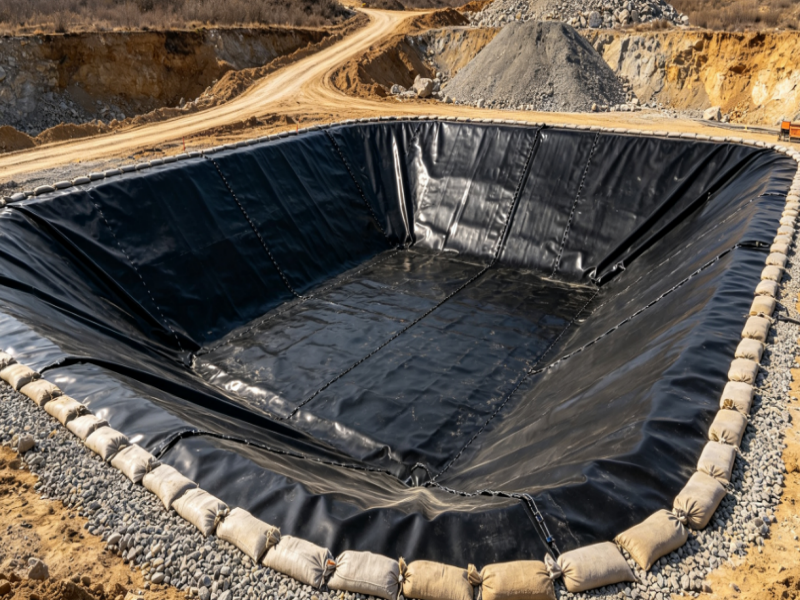
Different project scenarios correspond to targeted cost-effective geomembrane options. For budget-oriented stormwater ponds without harsh chemical erosion, recycled HDPE offers the lowest per-square-foot cost. Small-scale, short-term auxiliary wastewater pits can adopt PVC to reduce initial material investment. Standard LLDPE is suitable for temporary exploration facilities, while lithium brine projects prefer reinforced LLDPE for foundation deformation resistance. Smooth virgin HDPE is the universal choice for most tailings dams and landfills with balanced cost and performance. Underground backfill tunnels apply bituminous composite liners, high-risk acid heap leach pads require double textured HDPE, and arctic mining projects choose high-priced EPDM to avoid low-temperature liner failure.
5. Conclusion
Low geomembrane per-square-foot cost does not equal optimal long-term project value. Recycled HDPE and PVC can minimize upfront investment, but they carry huge hidden costs of replacement and maintenance for permanent high-hazard mining sites. Virgin HDPE series products remain the most cost-effective mainstream solution for global containment projects, achieving a perfect balance between unit material price, chemical stability and multi-decade service life. In project budgeting, engineers should focus on total lifecycle cost rather than isolated per-square-foot pricing, fully considering repair labor fees, project downtime losses and leakage-related regulatory penalties. Matching geomembranes with protective geotextiles can further reduce puncture damage, extend service life and maximize the return of containment barrier investment.