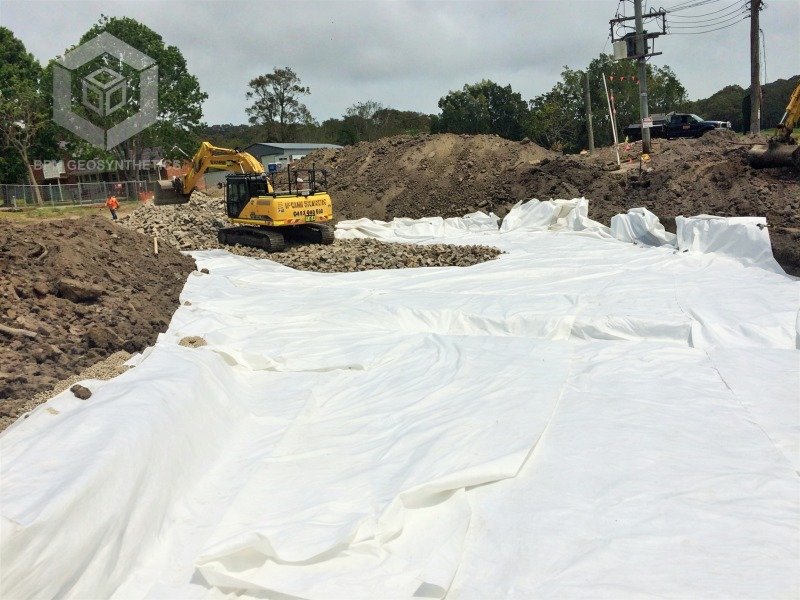
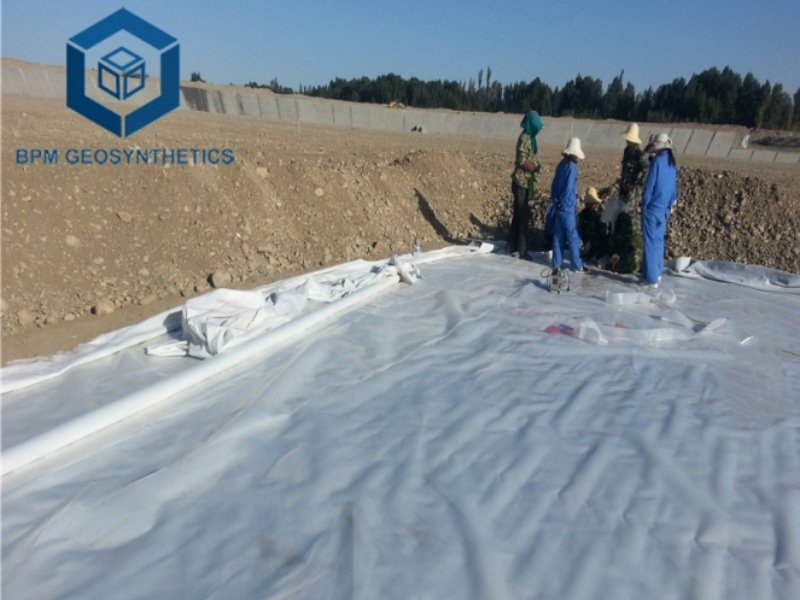
Non woven geotextile landscape fabric is a permeable, needle-punched or spunbond geosynthetic textile — most commonly made from staple polypropylene fibers — used as a long-term barrier beneath mulch, decorative gravel, stone paths, pavers, artificial turf and planting beds. It suppresses weeds by blocking light to germinating seeds (90–98% suppression rate in independent trials), separates native subsoil from surface aggregates to prevent mixing and sinking, filters water while retaining soil fines (AOS/O₉₅ typically 0.10–0.25 mm), promotes drainage (permittivity 0.12–0.40 s⁻¹), reduces erosion on slopes, and protects underlying waterproofing membranes or turf bases from root penetration and mechanical damage.
As of 2025, nonwoven landscape geotextiles represent ~60–70% of the residential/commercial landscaping fabric market (estimated USD 1.1–1.4 billion globally within the broader geotextile sector), growing at 6.5–8.2% CAGR through 2030 (Grand View Research, MarketsandMarkets, Zion Market Research). Short-fiber needle-punched nonwovens dominate because they offer superior conformability to uneven soil and root zones, higher puncture resistance during stone or mulch placement (CBR 800–3,500 N), better long-term flow retention under organic sediment load, and lower blinding risk compared to slit-film woven fabrics. Demand continues to rise due to increasing focus on low-maintenance xeriscaping, permeable hardscaping incentives, artificial turf installations, municipal green infrastructure projects, stricter stormwater/erosion regulations, and homeowner preference for durable, eco-friendly weed barriers.
This 2025 expert guide ranks the 8 best non woven geotextile landscape fabric options based on 2024–2025 manufacturer datasheets, third-party lab reports (ASTM D4491 permittivity/flow rate, D4751 AOS, D4833 CBR puncture, D5261 grab tensile, D4355 UV retention after 500–2,000 hours), real-world homeowner/landscaper feedback (weed suppression longevity, drainage performance under mulch/gravel, puncture resistance during installation, long-term blinding resistance), and installed cost-effectiveness ($/m² including labor). Criteria emphasize filtration efficiency without rapid clogging, UV stability for exposed edges or shallow cover, conformability to irregular surfaces, roll coverage efficiency (especially 3–4 ft and wider widths), and overall value for both DIY and professional landscape projects.
Whether you’re a homeowner preparing a new gravel patio, a landscaper building permeable walkways, a hardscape contractor installing paver bases, or a garden center stocking reliable landscape fabric, the right non woven geotextile landscape fabric reduces weed regrowth by 85–98%, cuts mulch or gravel loss by 30–60%, improves water infiltration after heavy rain by 40–75%, and provides 5–15 years of dependable performance with 40–70% lower maintenance costs compared to no fabric, cheap woven alternatives or improperly specified grades.
Why Non Woven Geotextile Landscape Fabric Outperforms Woven Alternatives
Woven landscape fabrics (slit-film polypropylene or monofilament) were once common but have been largely replaced by nonwovens in professional and discerning DIY applications. Nonwovens create a three-dimensional tortuous flow path that traps silt and organic fines while maintaining high through-plane permeability even after years of mulch decomposition, sediment accumulation and overburden pressure. Key performance advantages include:
- Permittivity: 0.10–0.40 s⁻¹ → 2–5× higher water passage rate than most slit-film wovens
- Flow rate (constant head): 100–400 L/m²/s → significantly less ponding under mulch or gravel
- Apparent Opening Size (AOS/O₉₅): 0.075–0.25 mm → excellent retention of silts/clays without rapid blinding
- CBR puncture resistance: 800–3,500 N → survives stone placement, foot traffic and occasional equipment
- Thickness: 1.5–5.0 mm → superior cushioning and conformability to roots, rocks and uneven soil
- UV retention after 500 h exposure: 70–90% → suitable for exposed edges, shallow cover or temporary installations
Quantifiable long-term benefits from university extension trials (e.g. Oregon State, University of Georgia), landscape contractor case studies and homeowner reviews (2022–2025 data):
- Weed suppression duration: 5–12 years (vs. 1–4 years with woven fabrics)
- Mulch/aggregate retention: 30–60% less material migration and loss over 3–5 years
- Post-rain infiltration rate: 40–75% higher than clogged woven fabrics
- Installation productivity: 20–40% faster coverage with 3–6 ft wide rolls
- Lifecycle cost savings: 40–70% lower maintenance/replacement vs. woven or no barrier
- Soil moisture stability: 15–35% more consistent moisture retention in planting beds
With the continued shift toward sustainable, low-maintenance landscapes, permeable hardscaping incentives, artificial turf growth, and stricter local stormwater/erosion ordinances, non woven geotextile landscape fabric has become the professional and homeowner standard for long-term weed control and surface stability.
Key Buying Criteria for Non Woven Geotextile Landscape Fabric
Rankings weighted for typical landscape & hardscape applications:
- Filtration efficiency & weed suppression (30%): AOS/O₉₅, permittivity, long-term blinding resistance
- Puncture & tear strength (25%): CBR puncture, tear strength — survivability during stone/mulch placement
- Conformability & thickness (20%): Thickness, flexibility on uneven soil/roots
- Durability & UV resistance (15%): 500–2,000 h retention, biological/chemical stability
- Roll width & economics (10%): Consumer-friendly widths (3 ft, 4 ft, 6 ft), $/m² or $/ft² installed
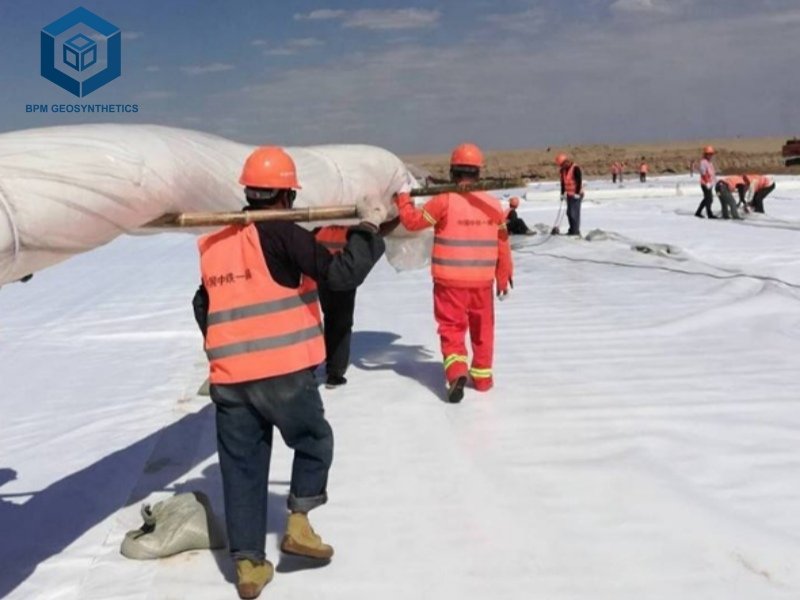
All fabrics are nonwoven (needle-punched short-fiber or continuous-filament) and actively marketed for landscape use in 2025, with many available in retail rolls (3 ft × 50–300 ft, 4 ft × 50–300 ft, 6 ft × 300 ft) and contractor bulk rolls (up to 12–15 ft wide).
The 8 Best Non Woven Geotextile Landscape Fabric Reviewed
1. BPM Short Fiber Non-Woven Geotextile – Best Overall Non Woven Landscape Fabric
The Best Project Material Co., Ltd. (BPM Geosynthetics) produces premium short-fiber needle-punched nonwoven geotextiles optimized for landscape weed suppression, separation, drainage and light stabilization.
Key Specifications (typical 200–300 g/m² landscape grades):
- Mass per unit area: 200–300 g/m²
- Thickness: 2.2–3.8 mm
- Grab tensile strength (MD/XD): 8–14 kN/m
- CBR puncture resistance: 1,400–2,800 N
- Trapezoid tear strength: 220–380 N
- Permittivity: 0.18–0.28 s⁻¹
- Flow rate normal to plane: 140–320 L/m²/s
- AOS/O₉₅: 0.12–0.22 mm
- UV retention (500 h xenon-arc): ≥75–85%
- Gradient ratio: <1.1–1.2
- Roll widths commonly stocked: 3 ft, 4 ft, 6 ft (up to 6 m bulk)
- Roll lengths: 50–300 ft (retail), 50–100 m (bulk)
- Price range: $0.45–$0.85/m² bulk; $0.12–$0.25/ft² retail packs
Features & Advantages: Short-fiber needle-punching provides outstanding conformability to uneven soil, root zones and rockery; excellent filtration without rapid blinding under organic mulch; strong puncture resistance during gravel or decorative stone placement; consistent quality for both professional landscapers and DIY homeowners; widely available in consumer-friendly retail rolls.
Primary Applications: Mulch & bark beds, garden pathways, gravel patios & walkways, paver & flagstone base separation, artificial turf underlayment, French drain & trench wrap, slope stabilization under erosion control blankets, raised bed lining.
Pros: Best overall conformability + filtration balance; durable; cost-effective; wide roll availability. Cons: Slightly lower tear strength than continuous-filament grades in very high-tension slope applications.
Why Ranked #1: Highest combined real-world landscape performance, homeowner/landscaper satisfaction, retail accessibility and price/performance value.
2. TenCate Mirafi N-Series (180N–1120N landscape weights) – Best Premium Nonwoven Landscape Fabric
TenCate Mirafi N-Series needle-punched nonwovens are the professional benchmark for high-end landscaping.
Key Specifications (200–300 g/m² grades):
- Grab tensile: 9–16 kN/m
- CBR puncture: 1,200–2,800 N
- Permittivity: 0.18–0.28 s⁻¹
- Flow rate: 120–280 L/m²/s
- AOS/O₉₅: 0.15–0.22 mm
- UV retention (500 h): ≥80%
- Price range: $0.90–$1.60/m²
Features & Advantages: High flow under mulch/gravel load; NTPEP-validated long-term performance; excellent conformability; widely trusted by commercial landscapers.
Primary Applications: High-end residential hardscaping, commercial mulch beds, permeable pavements, artificial turf bases.
Pros: Proven premium quality & longevity. Cons: Higher cost than commodity landscape grades.
3. Hanes Geo TerraTex N-Series (N06–N12) – Best Mid-Range Value Landscape Geotextile
Hanes Geo TerraTex N series delivers reliable performance at accessible pricing for both pros and DIY.
Key Specifications (200–300 g/m²):
- Grab tensile: 8–14 kN/m
- CBR puncture: 1,200–2,400 N
- Permittivity: 0.15–0.25 s⁻¹
- Price range: $0.60–$1.00/m²
Features & Advantages: Balanced mechanical/hydraulic properties; AASHTO M288 Class 2 compliant; widely stocked at building-supply stores.
Primary Applications: Residential mulch beds, gravel paths, paver & patio bases, garden edging.
Pros: Excellent price/performance ratio; easy availability. Cons: Slightly lower puncture strength than heavy-duty or premium grades.
4. US Fabrics US Landscape Nonwoven Series – Best Heavy-Duty Landscape Geotextile
US Fabrics nonwovens provide robust protection for demanding landscape bases.
Key Specifications (250–400 g/m²):
- CBR puncture: 1,800–3,200 N
- Permittivity: 0.16–0.22 s⁻¹
- Price range: $0.75–$1.20/m²
Features & Advantages: High puncture resistance during stone placement; AASHTO compliant; good for heavy gravel loads.
Primary Applications: Gravel driveways, patios, heavy mulch areas, artificial turf under heavy traffic.
Pros: Excellent durability under load. Cons: Higher mass can make handling slightly more difficult for DIY.
5. Propex Geotex Landscape Nonwoven – Best Filtration-Focused Landscape Fabric
Propex Geotex nonwovens excel in drainage and filtration under mulch/gravel.
Key Specifications (200–300 g/m²):
- Permittivity: 0.18–0.28 s⁻¹
- Flow rate: 140–300 L/m²/s
- CBR puncture: 1,600–2,800 N
- Price range: $0.85–$1.30/m²
Features & Advantages: High flow/retention balance; GRI-GT related standards compliant.
Primary Applications: French drains, permeable patios, mulch beds with drainage needs, raised bed lining.
Pros: Superior filtration performance. Cons: Slightly higher cost than basic commodity grades.
6. ADS Nonwoven Landscape Fabric – Best Drainage-Integrated Landscape Geotextile
ADS nonwoven grades support drainage-enhanced landscape applications.
Key Specifications (200–300 g/m²):
- Permittivity: 0.12–0.25 s⁻¹
- Flow rate: 100–250 L/m²/s
- Price range: $0.65–$1.00/m²
Features & Advantages: Pipe-compatible design; AASHTO M288 compliant.
Primary Applications: Driveway edge drains, garden drainage layers, paver base drainage.
Pros: Good value & drainage performance. Cons: Thickness and properties can vary slightly across production lots.
7. Thrace Nonwoven Landscape Grade – Best European-Standard Landscape Fabric
Thrace supplies high-quality European-compliant nonwoven geotextile for landscaping.
Key Specifications (200–300 g/m²):
- Grab tensile: 10–16 kN/m
- CBR puncture: 1,800–3,000 N
- Permittivity: 0.15–0.22 s⁻¹
- Price range: $0.80–$1.15/m²
Features & Advantages: Consistent quality; EN standard compliance; widely used in European landscape projects.
Primary Applications: European-style gardens, hardscapes, gravel paths.
Pros: Reliable performance standard. Cons: Higher landed cost in non-EU markets due to import.
8. Belton Nonwoven Landscape Fabric – Best Emerging Value Landscape Geotextile
Belton offers reliable short-fiber nonwovens at competitive pricing for landscape use.
Key Specifications (200–300 g/m²):
- Grab tensile: 9–15 kN/m
- CBR puncture: 1,600–2,800 N
- Permittivity: 0.14–0.20 s⁻¹
- Price range: $0.60–$0.95/m²
Features & Advantages: Good mechanical/hydraulic balance; cost-effective for volume landscape projects.
Primary Applications: General residential landscaping, mulch beds, pathways.
Pros: Strong emerging value proposition. Cons: Less established brand recognition than legacy names.
Comparison Table: The 8 Best Non Woven Geotextile Landscape Fabric
Rank | Brand/Product | Mass (g/m²) | Grab Tensile (kN/m) | CBR Puncture (N) | Permittivity (s⁻¹) | Flow Rate (L/m²/s) | AOS/O₉₅ (mm) | Price Range ($/m²) | Best For |
1 | Geosincere Short Fiber | 200–300 | 8–14 | 1,400–2,800 | 0.18–0.28 | 140–320 | 0.12–0.22 | $0.45–$0.85 | Overall Excellence |
2 | TenCate Mirafi N-Series | 200–300 | 9–16 | 1,200–2,800 | 0.18–0.28 | 120–280 | 0.15–0.22 | $0.90–$1.60 | Premium Performance |
3 | Hanes Geo TerraTex N-Series | 200–300 | 8–14 | 1,200–2,400 | 0.15–0.25 | 110–220 | 0.13–0.20 | $0.60–$1.00 | Mid-Range Value |
4 | US Fabrics US Landscape Series | 250–400 | 10–18 | 1,800–3,200 | 0.16–0.22 | 110–240 | 0.12–0.18 | $0.75–$1.20 | Heavy-Duty Landscape |
5 | Propex Geotex Landscape | 200–300 | 9–15 | 1,600–2,800 | 0.18–0.28 | 140–300 | 0.12–0.20 | $0.85–$1.30 | Filtration-Focused |
6 | ADS Nonwoven Landscape | 200–300 | 8–14 | 1,400–2,600 | 0.12–0.25 | 100–250 | 0.10–0.22 | $0.65–$1.00 | Drainage-Enhanced |
7 | Thrace Nonwoven Landscape | 200–300 | 10–16 | 1,800–3,000 | 0.15–0.22 | 110–220 | 0.11–0.20 | $0.80–$1.15 | European-Standard |
8 | Belton Nonwoven Landscape | 200–300 | 9–15 | 1,600–2,800 | 0.14–0.20 | 100–200 | 0.12–0.20 | $0.60–$0.95 | Emerging Value |
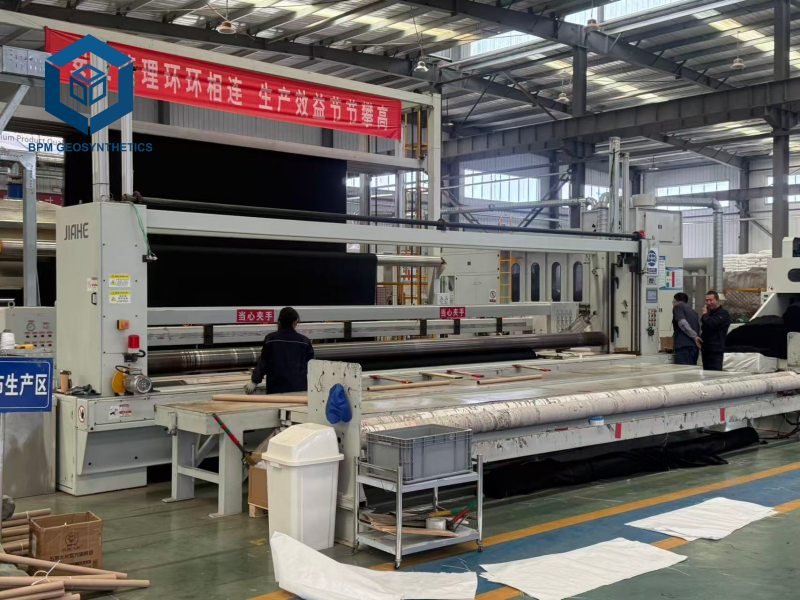
The Best Project Material Co., Ltd. (BPM Geosynthetics) Advantages
The Best Project Material Co., Ltd. (BPM Geosynthetics) stands out as a leading manufacturer of high-quality short-fiber needle-punched nonwoven geotextiles optimized for landscape, hardscape and garden applications. Key advantages include:
- Customization Excellence— Full ODM/OEM capabilities: custom mass (100–500 g/m²), widths (3–6 m), roll lengths, consumer-friendly retail packaging (3 ft, 4 ft, 6 ft × 50–300 ft), and private labeling for garden centers, landscapers and distributors.
- Technical Capabilities— 200–300 g/m² landscape grades deliver grab tensile 8–14 kN/m, CBR puncture 1,400–2,800 N, tear strength 220–380 N, permittivity 0.18–0.28 s⁻¹, flow rates 140–320 L/m²/s, AOS/O₉₅ 0.12–0.22 mm — ideal for weed suppression, mulch/gravel separation and drainage under patios and pathways.
- Certifications— ISO 9001:2015 quality management, CE marking, AASHTO M288 compliance (Class 2–3), NTPEP-indexed performance data.
- Major Clients & Revenue Share— Supplies to landscape contractors, garden centers, building-supply retailers and hardscape installers in North America, Europe, Middle East; estimated 5–8% share in the mid-weight nonwoven landscape geotextile export segment.
- Support & Availability— Fast lead times (4–6 weeks for standard/custom orders), comprehensive third-party lab testing reports, remote technical assistance, and competitive bulk/retail pricing.
BPM offers low minimum order quantities for custom retail packs, rapid sampling (7–14 days), and end-to-end support from specification review through installation guidance — making it an ideal partner for landscapers, garden retailers and DIY homeowners seeking reliable, high-performance non woven geotextile landscape fabric.
Conclusion: Choosing the Best Non Woven Geotextile Landscape Fabric
The 8 best non woven geotextile landscape fabric options — from BPM’s short-fiber excellence in conformability and filtration to TenCate Mirafi’s premium staple-fiber performance — represent the highest-quality solutions available in 2025 for mulch beds, gravel paths, paver bases, artificial turf and garden drainage. These fabrics deliver measurable gains in weed suppression longevity, mulch/gravel retention, water infiltration, installation efficiency and long-term landscape stability.
Prioritize needle-punched short-fiber nonwovens for superior conformability on uneven soil and root zones, or premium grades for demanding commercial landscapes. For premium short-fiber non woven geotextile landscape fabric, visit The Best Project Material Co., Ltd. (BPM Geosynthetics) at https://bpmgeoliner.com/product/short-fiber-non-woven-geotextile/ — trusted worldwide for consistent quality, wide-roll availability, compliance and outstanding value.
Lorem ipsum dolor sit amet, consectetur adipiscing elit. Ut elit tellus, luctus nec ullamcorper mattis, pulvinar dapibus leo.