Understanding Harga Geotextile Non Woven:
Note: “Harga” means “price” in Indonesian/Malay, so the topic essentially asks about the price of non-woven geotextile
Many customers in the search for geotextiles usually ask, ‘What is the price of non-woven geotextiles?’ However, to accurately answer this question, a thorough understanding of product specifications, materials, market trends, and procurement strategies is required. Non woven geotextiles are an important component of modern civil engineering, playing a crucial role in road construction, drainage systems, erosion control, and landfill management. This article answers fundamental questions about non-woven geotextiles, from basic definitions to advanced pricing factors, helping every customer make informed purchasing decisions. We will explore the manufacturing process, material composition, physical properties, and application requirements that ultimately determine the price per square meter.
1. What is Non-Woven Geotextile and How Does It Differ from Woven Geotextile?
1.1 Definition of geotextile non-woven
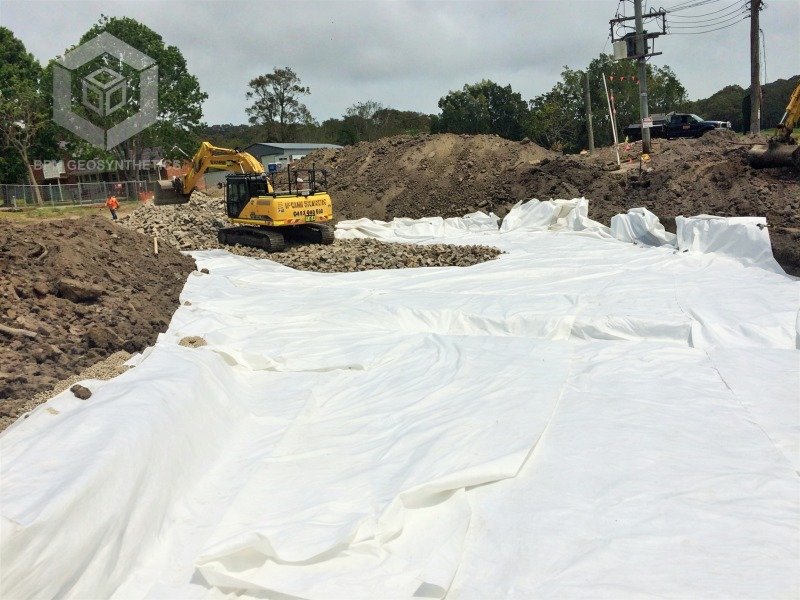
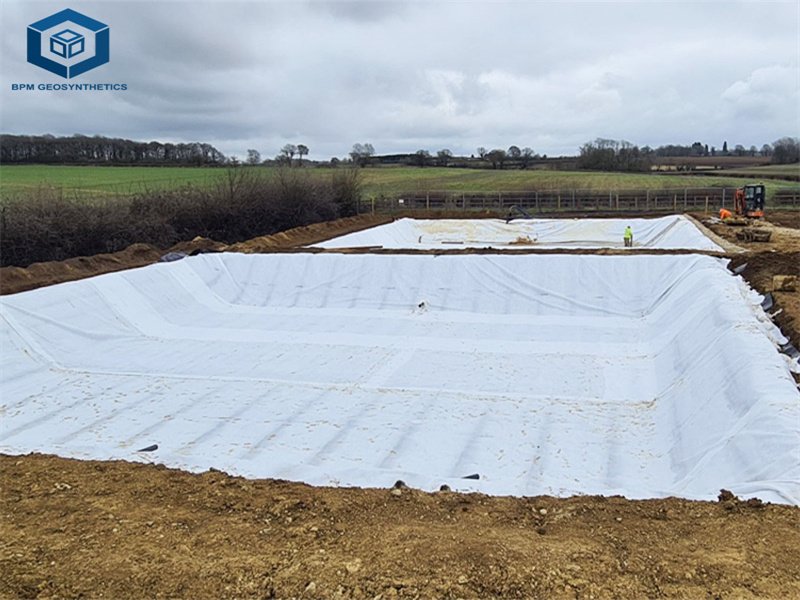
Nonwoven geotextiles are permeable synthetic fabrics manufactured not through traditional weaving, but through a needle-punching process.
Manufacturers use mechanical needle-punching technology to bond loosely arranged, randomly arranged layers of short fibers or filament continuous together to produce geotextile non woven.
1.2 Geotextile Non Woven: High-Porosity Fabric for Filtration and Drainage
This production method creates a fabric structure with high porosity and excellent permeability, making nonwoven geotextiles particularly suitable for filtration and drainage applications.
2. Differences between Nonwoven and Woven Geotextiles
2.1 Different Manufacturing Processes
- Woven geotextiles are formed by interlacing single yarns on a specialized loom, creating a mesh-like structure with high tensile strength and dimensional stability.
- Fabrics produced using this weaving process have tensile strengths ranging from 20 to 200 kN/m, making them ideal for heavy-duty reinforcement applications such as road construction and stabilization projects.
- However, the woven structure creates a surface with lower porosity, limiting its effectiveness in drainage applications, which require water flow.
2.2 Different Physical Properties
- Nonwoven geotextiles perform better in applications requiring high flow rates and soil filtration.
- The random arrangement of fibers creates interconnected pores, allowing water to pass freely while trapping soil particles.
- This structure typically has a tensile strength of 5 to 50 kN/m, sufficient for most separation, filtration, and protection functions. Although nonwoven fabrics wear out faster than woven fabrics due to the lack of reinforcing braided layers, they offer superior performance in controlling water accumulation and preventing soil migration.
3. Raw Materials Used in Geotextile Non Woven Manufacturing
3.1 PP(Polypropylene) non woven geotextile
Polypropylene (PP) dominates the non-woven geotextile market, comprising approximately 60% of all synthetic geotextile production . Manufacturers favor polypropylene for its excellent chemical resistance, hydrophobic properties, and cost-effectiveness. The material resists acids and alkalis across a pH range of 2 to 13, making it suitable for challenging environmental conditions including landfill applications and mining operations .
3.2 PET(Polyester) non woven geotextile
Polyester (PET) is the second most commonly used raw material, accounting for approximately 40% of the market share. Compared to polypropylene, polyester offers superior tensile strength and better UV resistance, and polyester filament geotextiles are less expensive than polypropylene, making them cost-effective in many projects. However, polyester has limitations in alkaline soil conditions, and hydrolysis can cause the material to degrade over time. Engineers must consider soil chemistry when selecting polyester geotextiles for long-term installation projects.
4. Typical Physical Properties of Geotextile Non Woven
4.1 The physical properties of nonwoven geotextiles determine their suitability for a variety of applications.
Manufacturers produce these fabrics in weights ranging from 80 to 800 grams per square meter (GSM), with thickness varying from 0.5 to 5.0mm. A standard 500 GSM non-woven geotextile typically measures 4mm in thickness and provides tensile strength of 27 to 29 kilonewtons per meter .
4.2 The mechanical properties scale proportionally with material weight.
- Breaking elongation typically ranges from 50 to 80 percent, providing the flexibility needed to conform to irregular ground surfaces .
- Static puncture resistance for a 500 GSM fabric reaches approximately 5500 Newtons, while dynamic puncture resistance measures about 3 mm.
- These puncture resistance characteristics prove essential when installing geotextiles over sharp subgrade materials or under aggregate layers.
4.3 Hydraulic properties define the filtration performance of non-woven geotextiles.
Water permeability typically reaches 0.025 meters per second, while the characteristic aperture size averages 0.1mm . These parameters allow water to pass freely while retaining fine soil particles, preventing clogging and maintaining long-term drainage performance.
5. Pricing Factors Influencing Harga Geotextile Non Woven
5.1 Typical Price Range for Non-Woven Geotextile
a. Non-woven geotextile prices in 2025 typically range from USD 0.20 to USD 2.50 per square meter, depending on specifications and order volume.
b. Lightweight materials for landscaping and weed control start at the lower end of this spectrum, while heavyweight fabrics for landfill liners and road stabilization command premium pricing.
c. For perspective, a standard 200 GSM polypropylene non-woven geotextile suitable for drainage applications typically costs between USD 0.50 and USD 1.00 per square meter from reputable manufacturers.
5.2 Regional variations significantly impact pricing.
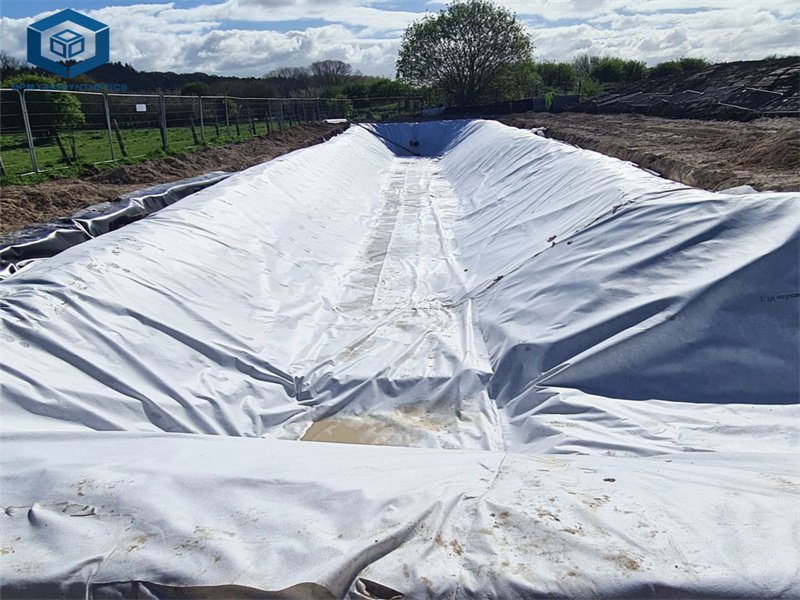
North American buyers typically pay USD 0.50 to USD 2.50 per square meter, reflecting higher labor costs and stringent regulatory requirements. Asian markets benefit from lower production costs, with Chinese manufacturers offering competitive pricing from USD 0.20 to USD 2.00 per square meter. European prices range from USD 0.40 to USD 2.50 per square meter, with premium brands like Fibertex commanding USD 1.00 to USD 2.00 per square meter
6. How Fabric Weight (GSM) Affects Price
6.1 Material weight stands as the primary determinant of non-woven geotextile pricing
6.1.1 Heavier fabrics require more raw materials, thus increasing their cost.
- Lightweight materials from 80 to 150 GSM cost USD 0.20 to USD 0.80 per square meter, serving applications like landscape weed barriers and temporary erosion control.
- Medium-weight fabrics from 150 to 400 GSM range from USD 0.50 to USD 1.50 per square meter, providing the durability needed for drainage systems and permanent erosion control installations.
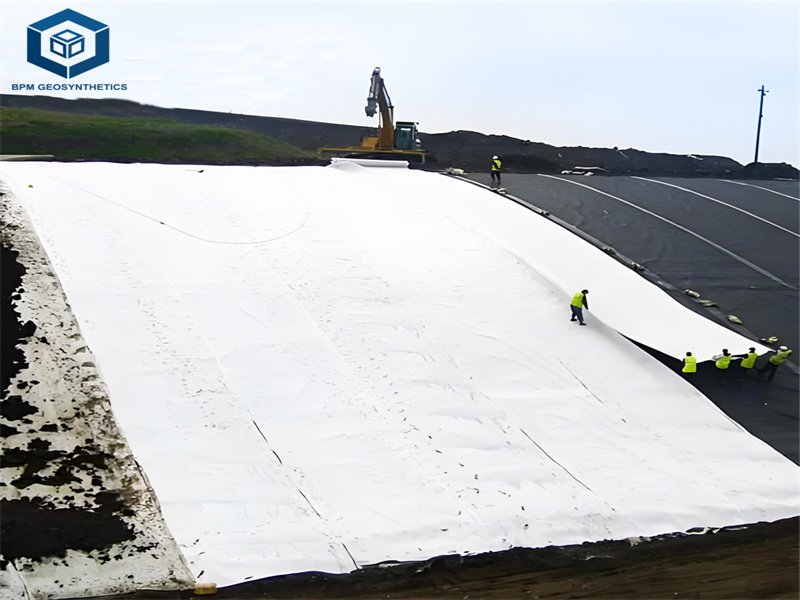
- Heavyweight geotextiles from 400 to 800 GSM cost USD 1.00 to USD 2.50 per square meter, delivering the puncture resistance and strength required for landfill liners and road base stabilization.
6.2 The price increases approximately linearly with weight.
Economies of scale in production will slow the rate of price increases. 400 GSM fabric typically costs about twice as much as 200 GSM fabric, but the heavier material offers greater puncture resistance and durability, making the additional investment worthwhile for demanding applications.
7. Price Differences Between Local and Imported Products
Local manufacturing offers distinct advantages in terms of reduced shipping costs, shorter lead times, and easier communication. Local suppliers understand regional soil conditions, regulatory requirements, and construction practices, often providing valuable technical support that imported suppliers cannot match.
Chinese manufacturers, particularly those concentrated in Shandong Province’s manufacturing hubs, achieve significant economies of scale that translate to lower unit costs. Facilities exceeding 5,000 square meters with multiple production lines running continuously can produce monthly outputs ranging from hundreds to over 3,000 metric tons. This scale enables Chinese exporters to offer prices 20 to 35 percent lower than comparable domestic suppliers in many markets, especially for volumes above 1,000 kilograms. However, buyers must factor in shipping costs, import duties, and longer lead times when comparing imported versus local options.
BPM Geosynthetics is a geotextile manufacturer in China. They have multiple geotextile production lines, capable of producing geotextiles with weights ranging from 100g to 1500g. A variety of lengths, widths, and colors are available. They can provide customized services for different clients and markets. Geotextiles offer high cost-performance.
8. Impact of Raw Material Costs on Final Pricing
Raw material costs, particularly crude oil derivatives like polypropylene and polyester, significantly influence geotextile pricing. When crude oil prices fluctuate due to supply chain disruptions or geopolitical factors, production costs for these petrochemicals swing unpredictably. This instability creates pricing uncertainty for manufacturers, who struggle to maintain fixed quotes for long-term infrastructure contracts. Contractors may postpone procurement or seek lower-cost alternatives to prevent budget overruns.
The geotextile industry’s heavy reliance on fossil-fuel-based fibers amplifies this vulnerability. Global polyester production reached 78 million tons in 2024, representing 59 percent of total world fiber output. Since polyester comprises the vast majority of geotextile composition, the market remains intrinsically linked to petroleum industry economics. Even minor disturbances in global oil markets can cause disproportionate financial effects throughout the supply chain, complicating financial planning and squeezing profit margins for producers.
Conclusion
Non-woven geotextile prices depend on material weight (GSM), raw polymer costs, and sourcing location. Polypropylene and polyester dominate manufacturing, with Chinese suppliers (like BPM Geosynthetics )offering competitive pricing due to economies of scale. Heavier fabrics command higher prices but deliver superior performance for demanding applications. Buyers must balance unit cost against shipping expenses, lead times, and technical requirements to make informed procurement decisions that ensure project success.