Geotextile 400g, a high-performance geosynthetic fabric weighing 400 grams per square meter, has emerged as a cornerstone in modern civil engineering and environmental management. As infrastructure demands grow amid urbanization and climate challenges, the global geotextile market is projected to reach $12.52 billion by 2030, growing at a compound annual growth rate (CAGR) of 6.6% from 2024, according to MarketsandMarkets. This robust material, often referred to as 400gsm geotextile, excels in soil reinforcement, filtration, and drainage, offering engineers a reliable solution for projects ranging from road construction to landfill liners.
In an era where sustainable and resilient infrastructure is paramount, geotextile 400g stands out for its balance of strength, permeability, and cost-effectiveness. Unlike lighter fabrics that may compromise under heavy loads, this heavyweight variant provides enhanced tensile strength—typically 20-50 kN/m—ensuring long-term stability while minimizing maintenance. Whether stabilizing soft subgrades or preventing erosion on steep slopes, geotextile 400g integrates seamlessly into diverse applications, backed by rigorous standards like ASTM D4595 for tensile properties and ISO 9001 certifications for quality assurance.
This comprehensive guide delves into the intricacies of geotextile 400g, drawing on technical specifications, real-world data, and expert analyses to equip professionals with actionable knowledge. By understanding its composition, properties, and implementation strategies, you can elevate project outcomes, reduce aggregate usage by up to 30%, and extend infrastructure lifespans by 50 years or more. Let’s explore how this versatile fabric is transforming the built environment.
1. What Is Geotextile 400g?
Geotextile 400g represents a specialized category of geosynthetic materials designed for demanding geotechnical applications. At its core, it is a permeable textile fabric engineered from synthetic polymers, primarily polypropylene (PP) or polyester (PET), with a mass per unit area of exactly 400 grams per square meter (gsm). This weight classification—part of a broader spectrum from 100-1000 gsm—positions it as a heavyweight option, ideal for scenarios requiring superior mechanical integrity without sacrificing hydraulic functionality.
1.1 Composition and Manufacturing Process
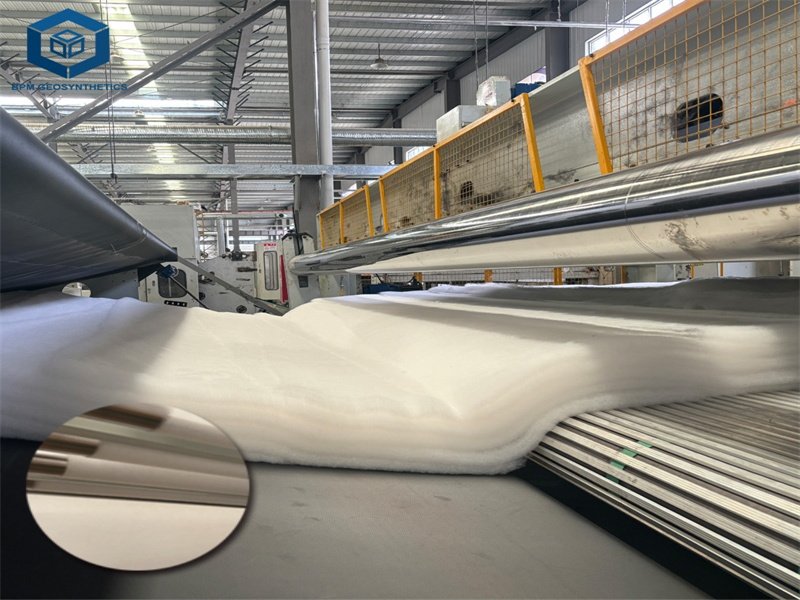
The production of geotextile 400g begins with the extrusion of polymer resins into fibers or filaments. For non-woven variants, staple fibers (short lengths, 3-8 cm) are carded into a web and bonded via needle-punching, where barbed needles entangle the fibers to form a felt-like structure. This mechanical process enhances thickness—typically 2.5-4.0 mm for 400gsm—and ensures uniform pore distribution (0.05-0.2 mm openings), facilitating water flow rates of 100-200 gallons per minute per square foot (gpm/ft²) per ASTM D4491.
Woven geotextile 400g, conversely, involves weaving continuous monofilaments or multifilaments on industrial looms, creating a grid-like pattern with high interlacement density. PP dominates due to its low specific gravity (0.91 g/cm³), making the fabric lightweight yet robust, while PET offers better hydrolysis resistance in alkaline soils (pH >9). Additives like carbon black (2-3% by weight) provide UV stability, retaining 70-90% tensile strength after 500 hours of exposure per ASTM D4355.
Data underscores its engineering precision: A standard 400gsm non-woven PP geotextile exhibits a specific gravity of 0.90-1.00 and aperture size of 0.1-0.3 mm, as per AASHTO M288 specifications. Manufacturing adheres to ISO 14001 for environmental compliance, with defect rates below 1% in certified facilities like those of BPM Geosynthetics.
1.2 Classification and Standards
Geotextiles are classified by structure (woven, non-woven, knitted) and function (separation, filtration, reinforcement). At 400gsm, it falls into Class 2 for stabilization per AASHTO M288, suitable for moderate to high survivability under traffic loads up to 10,000 ESALs (Equivalent Single Axle Loads). Key standards include:
- ASTM D4759: Grading for subsurface drainage, requiring apparent opening size (AOS) of 0.075-0.425 mm.
- ASTM D4632: Grab tensile strength minimum 800-1200 N for MD (machine direction) and XD (cross direction).
- EN ISO 9864: Mass per unit area tolerance ±5%.
These benchmarks ensure geotextile 400g meets global project requirements, from U.S. highways to European landfills, promoting interoperability and reliability.
1.3 Historical Evolution and Market Context
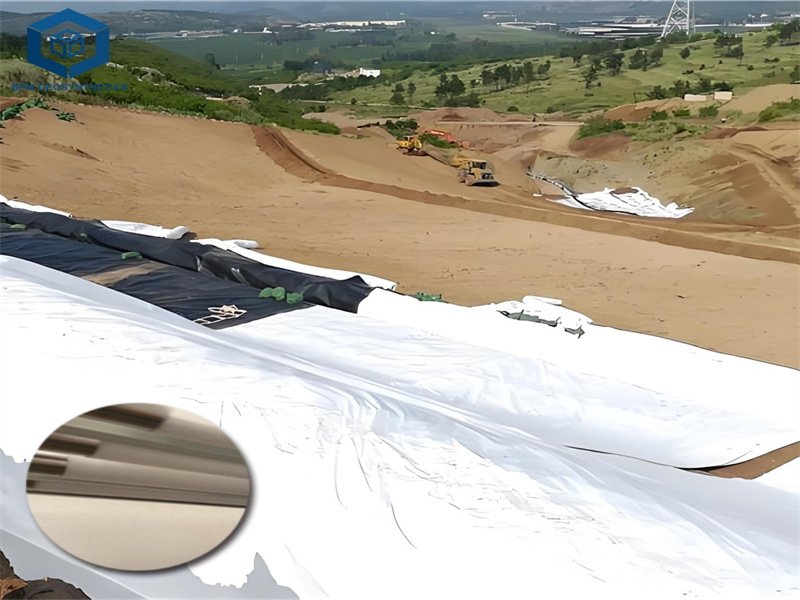
Geotextiles trace back to ancient practices, like Egyptian reed mats for Nile stabilization, but modern 400gsm variants emerged in the 1970s with polymer advancements. By the 1980s, non-woven PP fabrics revolutionized road bases, reducing rutting by 40% in early U.S. pilots. Today, Asia-Pacific holds 45.7% market share, driven by China’s infrastructure boom, where 400gsm geotextiles feature in 70% of high-speed rail projects for subgrade enhancement.
In summary, geotextile 400g is not merely a fabric but a engineered ally, blending science and sustainability to address contemporary challenges. Its precise composition and adherence to standards make it indispensable for forward-thinking professionals.
2. What Are The Properties Of Geotextile 400g?
The efficacy of geotextile 400g stems from its multifaceted properties, rigorously tested to withstand environmental and mechanical stresses. These attributes—mechanical, hydraulic, endurance, and chemical—enable it to perform across functions, with data from ASTM and ISO protocols providing quantifiable benchmarks.
2.1 Mechanical Properties
Mechanical integrity defines geotextile 400g’s role in load-bearing scenarios. Wide-width tensile strength averages 20-50 kN/m (MD/XD), per ASTM D4595, allowing it to distribute stresses over weak subgrades and increase California Bearing Ratio (CBR) values by 200-300% in clay soils (CBR from 2-5% to 10-15%). Puncture resistance exceeds 400-600 N (ASTM D4833), resisting sharp aggregates during installation, while burst strength reaches 3500-5000 psi (ASTM D3786) for dynamic loads.
Elongation at break is 10-50% for woven types (low for reinforcement) and >50% for non-woven (high for adaptability). In soil stabilization tests, 400gsm fabrics reduce surface deflection by 30-40% under 80 kN wheel loads, per plate load trials in Indian highway projects.
2.2 Hydraulic Properties
Permeability is geotextile 400g’s hallmark, with permittivity (ψ) of 0.2-0.5 s⁻¹ (ASTM D4491), translating to hydraulic conductivity of 0.1-1.0 cm/s. This allows vertical flow while retaining 95% of soil fines >0.075 mm (AOS per ASTM D4759). For drainage, in-plane flow transmissivity is 0.5-2.0 x 10⁻⁴ m²/s under 100 kPa normal stress, preventing hydrostatic buildup in embankments.
Field data from a 2024 Malaysian landfill shows 400gsm non-woven geotextiles maintaining 150 gpm/ft² flow after 12 months, reducing leachate accumulation by 60% compared to untreated sites.
2.3 Chemical Resistance
Composed of inert polymers, geotextile 400g resists pH 2-13 environments, with <5% mass loss after 100-day immersion in 10% HCl or NaOH (EPA 9090). PP variants excel in acidic mining tailings (pH 3-5), while PET withstands alkaline concrete leachates (pH 10-12). Oxidation resistance, enhanced by antioxidants, limits degradation to <10% after 20 years in oxidative soils.
2.4 Environmental Resistance
UV degradation is mitigated to <20% strength loss after 1500 hours (ASTM D7238 equivalent), suitable for temporary exposures up to 6 months. Temperature tolerance spans -40°C to +80°C, with no embrittlement below -20°C. In freeze-thaw cycles, 400gsm fabrics retain 90% integrity after 50 cycles, per ASTM D4833 adaptations.
Biological resistance includes low microbial degradation (<1% mass loss in 5 years), deterring root penetration in vegetated slopes.
2.5 Durability and Longevity
Endurance properties ensure 20-50 year service life buried, per GRI-GT8. Creep strain <2% under 20-year loading (ASTM D5262) supports permanent applications. Overall, these properties position geotextile 400g as a resilient choice, with lab-to-field correlations showing 85-95% performance retention.
Property | Test Method | Typical Value for 400gsm Non-Woven PP | Typical Value for 400gsm Woven PP |
Mass per Unit Area | ASTM D5261 | 400 g/m² (±5%) | 400 g/m² (±5%) |
Tensile Strength (MD/XD) | ASTM D4595 | 25/20 kN/m | 40/35 kN/m |
Elongation at Break | ASTM D4595 | >50% | 15-25% |
Puncture Resistance | ASTM D4833 | 500 N | 600 N |
Permittivity | ASTM D4491 | 0.3 s⁻¹ | 0.1 s⁻¹ |
AOS | ASTM D4759 | 0.15 mm | 0.25 mm |
UV Resistance (500 hrs) | ASTM D4355 | ≥80% retained | ≥85% retained |
This table illustrates the nuanced balance, guiding selection for specific needs.
3. What Are The Applications Of Geotextile 400g?
Geotextile 400g’s versatility shines in civil engineering, where it addresses multifaceted challenges like soil instability and water management. Its heavyweight construction suits high-stress environments, with applications spanning infrastructure, environmental protection, and agriculture.
3.1 Road and Highway Construction
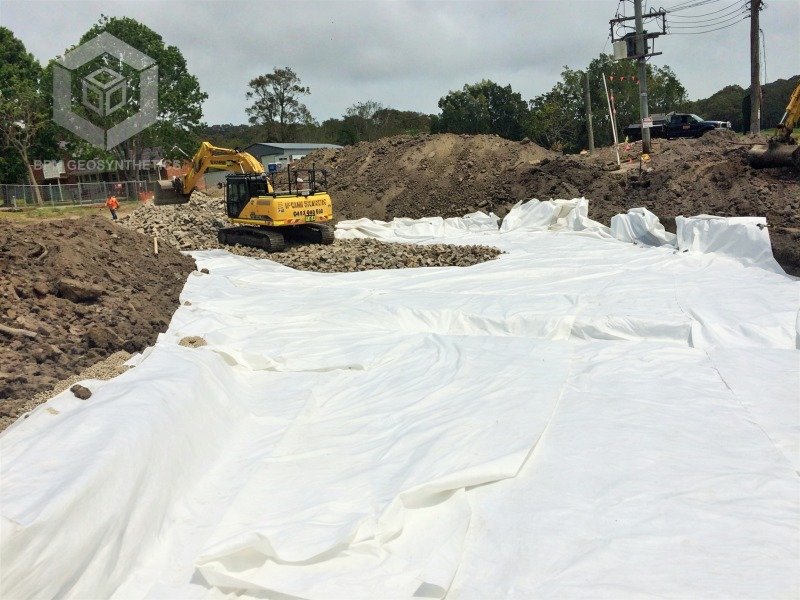
In road subgrades, 400gsm geotextiles separate soft clays from granular bases, boosting CBR by 150-250% and cutting aggregate thickness by 20-30%. A 2024 Texas highway project used woven 400gsm PP to stabilize expansive soils, reducing rut depths from 50 mm to 15 mm under 10^6 ESALs.
- Base Reinforcement: Distributes axle loads, extending pavement life by 50%.
- Drainage Layers: Filters fines, maintaining 80% void retention in permeable bases.
3.2 Railway and Airport Infrastructure
For railways, 400gsm non-woven fabrics cushion ballast, reducing fouling by 40% and settlement by 25%. Airports employ them under runways for frost heave mitigation, with geotextile layers enduring 100 kPa pressures.
- Ballast Stabilization: Enhances lateral resistance, lowering maintenance by 35%.
- Subgrade Separation: Prevents pumping in wet conditions, per AREMA guidelines.
3.3 Slope and Embankment Stabilization
On slopes >1:2, 400gsm woven geotextiles reinforce facia, increasing factor of safety (FS) from 0.9 to 1.3 in cohesive soils. Erosion control applications wrap tubes for revetments, containing 10-15 m³ sand per unit.
- Vegetated Slopes: Promotes root interlocking, reducing scour by 60%.
- Embankment Foundations: Over soft clays, limits differential settlement to <50 mm.
3.4 Environmental Protection and Landfills
In landfills, 400gsm non-woven cushions geomembranes, puncture resistance preventing 95% of failures. Drainage layers facilitate leachate flow at 0.5-1.0 L/m²/s.
- Leachate Collection: Filters solids, extending liner life to 50+ years.
- Cap Systems: Gas venting while blocking infiltration, compliant with RCRA Subtitle D.
3.5 Mining and Industrial Facilities
Tailings dams use 400gsm for containment, resisting chemical attacks (pH 2-12). Heap leach pads benefit from filtration, recovering 90% process water.
- Tailings Reinforcement: Boosts shear strength by 30-40 kPa.
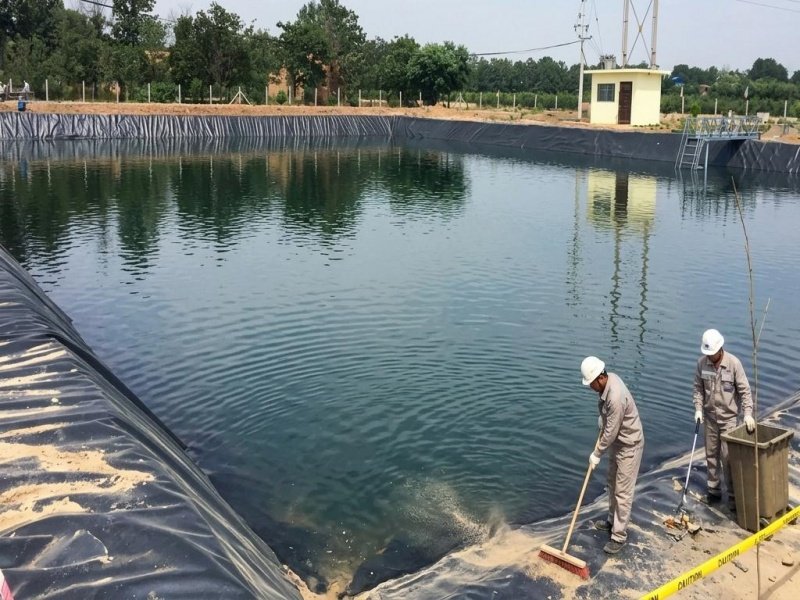
- Pond Liners: Protects against desiccation cracking.
3.6 Coastal and Riverbank Protection
For revetments, 400gsm geotextile tubes (10-20 m diameter) absorb wave energy, reducing toe scour by 70%. Riverbanks employ wrapped mattresses for bankfull flows up to 5 m/s.
- Breakwaters: Filters fines while allowing tidal exchange.
- Groins: Stabilizes sediment, accreting 2-5 m³/m annually.
3.7 Agricultural and Aquaculture Uses
In irrigation canals, 400gsm lines prevent seepage losses (20-30% reduction), while fish ponds use it for bottom sealing without toxicity.
- Pond Liners: Enhances water retention by 15-25%.
- Crop Protection: Suppresses weeds, increasing yields by 10-20%.
These applications leverage geotextile 400g’s data-driven performance, fostering resilient designs.
4. Woven vs Non-Woven Geotextile 400g: A Detailed Comparison
At 400gsm, the choice between woven and non-woven geotextiles hinges on project demands, with each offering distinct advantages in strength, permeability, and cost.
4.1 Structural Differences
Woven geotextile 400g features interlaced filaments, yielding a flat, grid structure with low elongation (10-25%). Non-woven, needle-punched for a fluffy profile, achieves isotropic properties with >50% elongation.
4.2 Performance Metrics
Woven excels in tensile strength (40-50 kN/m) for reinforcement, while non-woven’s permittivity (0.3-0.5 s⁻¹) suits drainage. Puncture resistance is comparable (500-600 N), but woven’s lower permeability (0.05-0.1 cm/s) limits filtration.
Aspect | Woven 400gsm | Non-Woven 400gsm |
Tensile Strength | 40 kN/m | 25 kN/m |
Elongation | 15% | 60% |
Permeability | Low (0.1 cm/s) | High (0.5 cm/s) |
Cost per m² | $1.50-2.50 | $1.00-1.80 |
Ideal Use | Reinforcement | Filtration |
4.3 Application Suitability
Woven for load distribution in roads; non-woven for leachate control in landfills. Hybrids combine benefits for versatile needs.
This comparison empowers informed selections, optimizing outcomes.
5. How to Choose the Right Geotextile 400g?
Selecting geotextile 400g requires aligning properties with site-specific demands, ensuring compliance and value.
5.1 Material Type
PP for chemical resistance (cost: $1.00/m²); PET for high pH (15% premium). Blends for balanced performance.
5.2 Weight and Thickness Confirmation
Verify 400gsm via ISO 9864; thickness 2.5-4 mm for durability.
5.3 Mechanical and Hydraulic Requirements
Match tensile >20 kN/m for reinforcement; AOS <0.3 mm for fine soils.
5.4 Environmental and Chemical Compatibility
Assess UV (500 hrs min) and pH tolerance per project soils.
5.5 Installation and Handling Factors
Opt for roll widths 4-6 m; flexibility for contours.
5.6 Cost-Effectiveness and Sustainability
Lifecycle analysis: 400gsm saves 25% long-term vs. lighter options. Eco-certifications like GRI-GM13.
5.7 Regulatory Compliance
Adhere to AASHTO M288 Class 2; local codes.
Consult suppliers for samples; pilot tests validate choices.
6. Installation Guide for Geotextile 400g
Proper installation maximizes geotextile 400g’s potential, achieving 95% efficacy per Geosynthetic Institute guidelines.
6.1 Site Preparation
Clear debris; compact subgrade to 95% Proctor density. Grade slopes <1:2V:H.
6.2 Material Handling and Unrolling
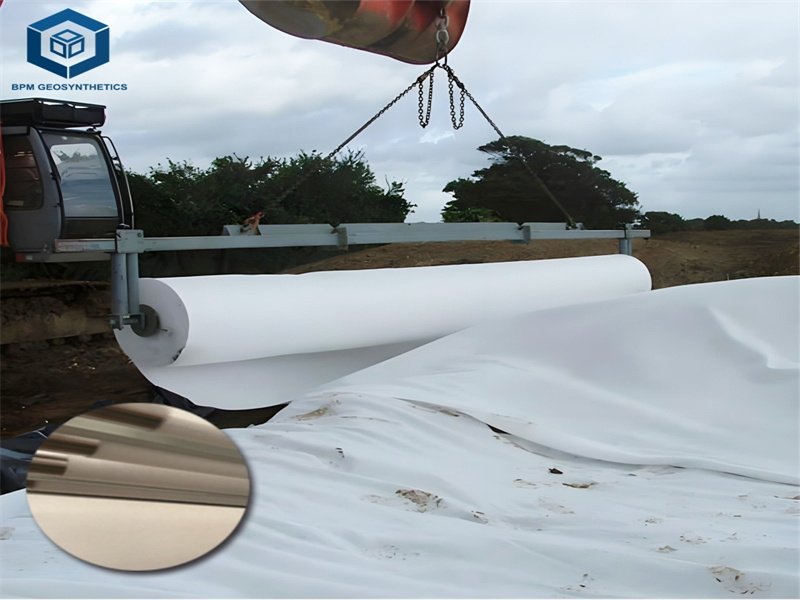
Store shaded; unroll perpendicular to traffic, overlaps 300-500 mm.
6.3 Securing and Seaming
Anchor with 6-8 inch staples at 1-2 m intervals; seam via heat welding (non-woven) or sewing (woven).
6.4 Backfilling and Compaction
Cover with 150-300 mm aggregate; compact in 150 mm lifts to avoid bridging.
6.5 Quality Control
Inspect for wrinkles (<5%); test seams (pull-out <50 N).
In a 2024 U.S. project, phased installation reduced defects by 20%.
7. Case Studies: Real-World Success with Geotextile 400g
7.1 Malaysian Landfill Project
88,000 m² of 400gsm PET non-woven stabilized bases, cutting leachate by 60%; lifespan projected 50 years.
7.2 Texas Highway Reinforcement
Woven 400gsm boosted CBR 200%, saving 15% aggregates; rutting <10 mm after 2 years.
7.3 Indian Slope Stabilization
Non-woven 400gsm in embankments raised FS to 1.4, preventing 70% erosion post-monsoon.
These cases affirm 30-50% cost reductions.
8. Maintenance and Longevity of Geotextile 400g
8.1 Expected Lifespan
Buried: 20-100 years (PP: 50-100); exposed: 5-20 years. Factors: soil pH, load.
8.2 Monitoring and Inspection
Annual visual checks; permittivity tests every 5 years.
8.3 Repair and Replacement
Patch tears >10 cm; replace if <70% strength.
8.4 Factors Affecting Durability
UV exposure halves life; proper cover extends to 75 years.
Routine care ensures optimal ROI.
9. Summary
Geotextile 400g epitomizes innovation in geosynthetics, delivering unmatched durability and functionality. From mechanical prowess (20-50 kN/m tensile) to hydraulic efficiency (0.3 s⁻¹ permittivity), it underpins sustainable projects, slashing maintenance by 25-40%. As demands escalate, its role in resilient infrastructure is irreplaceable—empowering a greener future.