In modern civil engineering, selecting the appropriate geocell material is crucial for improving project stability and economic benefits. This article provides an in-depth analysis of eight mainstream materials currently on the market, covering core materials such as high-density polyethylene (HDPE), polypropylene (NPA), and polypropylene (PP).
BPM Geosynthetics, as a geocell manufacturer, provides authoritative selection guidelines for road reinforcement, slope protection, and retaining wall construction through comparative evaluation of various indicators, helping engineers achieve the optimal balance between structural safety and sustainable development.
1. What is Geocell
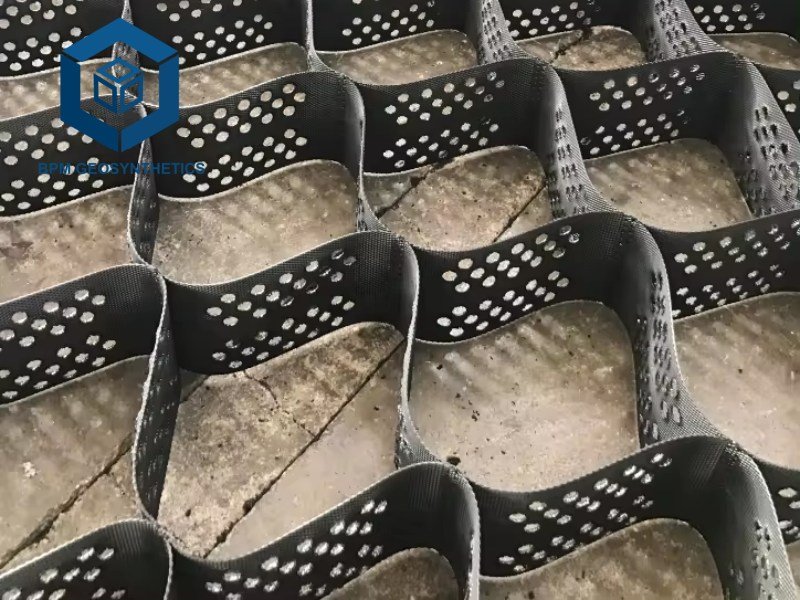
A geocell is a three-dimensional, honeycomb-like cellular confinement system. It is made from interconnected polymer strips that, when expanded, form walls that enclose and stabilize infill materials (such as soil, gravel, sand, or concrete).
The fundamental principle behind a geocell is lateral confinement. By restricting the horizontal movement of soil particles, the geocell increases the shear strength and stiffness of the soil layer. This creates a rigid mattress-like structure that distributes heavy loads over a wider area, preventing erosion and structural failure.
2. What Types of Materials are Used in Geocells?
2.1. High-Density Polyethylene (HDPE)
HDPE is the industry standard material for geocell and is widely used in applications such as road construction and slope protection
Characteristics: Excellent chemical resistance, high flexibility, and great UV resistance (usually containing 2-3% carbon black).
2.2 Novel Polymeric Alloys (NPA)
NPA is a high-performance material specifically engineered to solve the creep issues of standard HDPE. It is often a blend of various polymers reinforced with nano-fibers.
Characteristics: Extremely high stiffness (elastic modulus), high resistance to permanent deformation, and excellent thermal stability.
2.3. Polypropylene (PP)
Polypropylene is occasionally used for geocells that require higher rigidity at a lower cost than specialized alloys.
Characteristics: Higher melting point than HDPE and very stiff.
2.4. Woven/Non-Woven Polyester (PET)
Instead of solid plastic sheets, some geocells are made from high-tenacity polyester geotextiles.
Characteristics: Highly permeable (allows water to flow through the cell walls) and high tensile strength.
3. Which material offers the best balance between flexibility and stiffness?
3.1. The Industry Benchmark: HDPE Geocell Material
High-Density Polyethylene (HDPE) is widely recognized for offering the most practical balance for general engineering. It provides sufficient hoop strength to confine infill while maintaining high ductility. This allows the geocell to conform to irregular subgrades or steep slopes without the risk of brittle fracture.
3.2 Structural Integrity: NPA and PP Geocell Material
Novel Polymeric Alloys (NPA): These materials lean heavily toward stiffness. While they offer superior load support by minimizing cell wall deformation, they are less flexible during installation.
Polypropylene (PP): PP offers higher initial stiffness than HDPE but can become brittle in cold temperatures, potentially compromising its flexible “balance” in variable climates.
4. How do the tensile strength and weld peel strength of these three materials compare?
4.1. NPA (Novel Polymeric Alloy): The Performance Leader
NPA is specifically engineered for high-stress environments, and its technical data reflects this.
Tensile Strength: Highest in the group. Because NPA contains specialized resins and reinforcing fibers, it maintains its strength even under long-term, constant loading.
Weld Peel Strength: Superior. The molecular bond in NPA welds is designed to resist “fatigue,” meaning the seams are much less likely to snap under the repetitive “pulsing” loads of heavy traffic (like trucks or trains).
4.2. Geocell Material HDPE (High-Density Polyethylene): The Industry Standard
HDPE offers reliable strength that meets most international standards (like GRI-GS13), but it is generally lower than NPA.
Tensile Strength: Strong and reliable, but it has a lower “Elastic Modulus.” This means that while it is hard to break, it will stretch (creep) more than NPA before reaching its breaking point.
Weld Peel Strength: Excellent for standard applications. HDPE welds are very consistent because the material melts and bonds easily. However, in extreme heat, the weld strength can decrease more significantly than in alloy-based materials.
4.3. Geocell Material PP (Polypropylene): The Rigid Contender
PP is naturally stiffer than HDPE, which translates to high initial tensile strength, but it faces challenges with weld consistency.
Tensile Strength: Very high initial resistance to stretching. It feels “stiffer” to the touch than HDPE.
Weld Peel Strength: Variable. Polypropylene is notoriously more difficult to weld ultrasonically than Polyethylene. While a well-made PP weld is strong, it can be more “brittle,” meaning it might snap suddenly under a sharp impact rather than stretching.
5. Which geocell material is rated highest for UV resistance and long-term durability in harsh climates?
5.1 Rated Highest for UV Resistance and Durability
5.1.1 UV Protection and Chemical Stability
HDPE is generally rated highest for long-term environmental durability. By incorporating 2% to 3% Carbon Black, HDPE geocells achieve exceptional UV resistance, allowing them to remain exposed to intense sunlight for decades without losing tensile strength. Its inert chemical nature also protects it from acidic or alkaline soils.
5.2 Long-Term Performance in Harsh Climates
NPA for Creep Resistance: In “harsh” structural environments (like heavy traffic), NPA is rated highest because it resists long-term creep (stretching) better than HDPE.
Thermal Stability: HDPE remains flexible at temperatures as low as -40℃, whereas PP may crack. For extreme thermal cycling, HDPE’s durability remains the global standard.
6. Which of the geocell materials is most effective for heavy-duty load support in road construction?
6.1 Heavy-Duty Load Support: The Case for NPA Geocell Material
6.1.1 Structural Rigidity and Creep Resistance
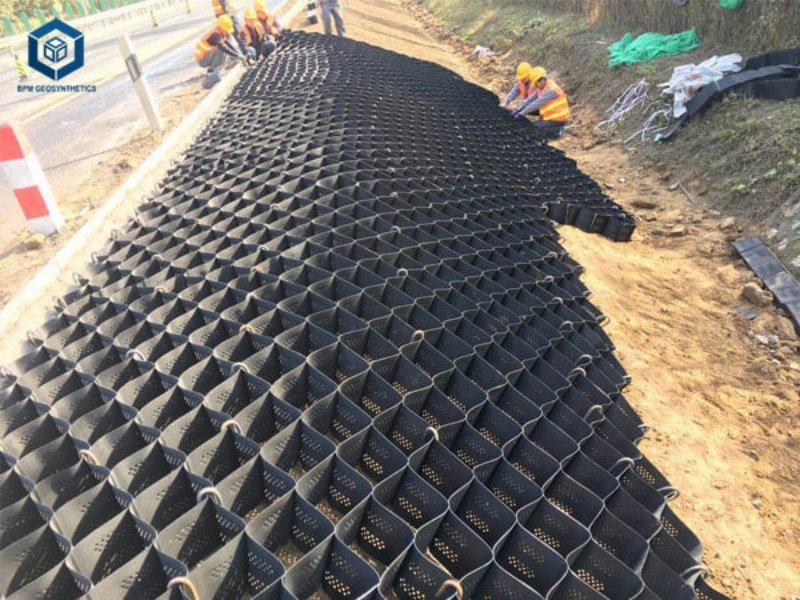
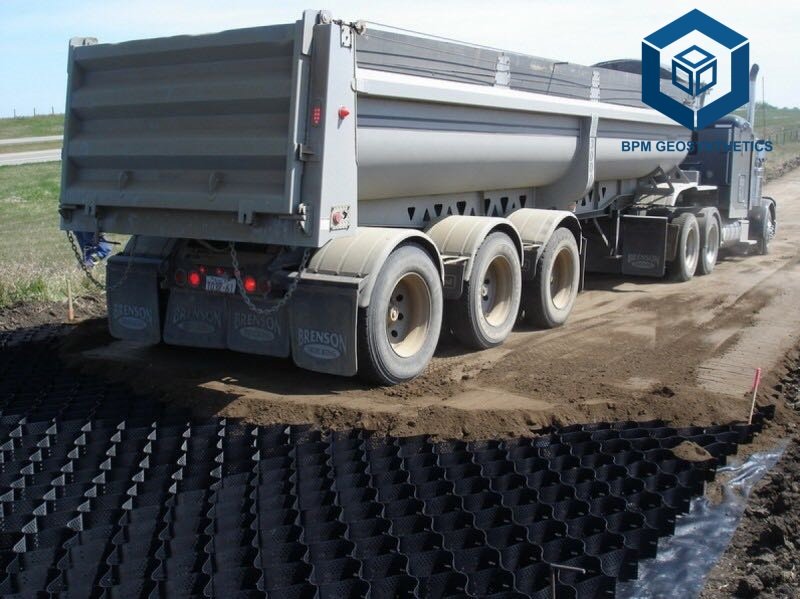
For heavy-duty load support—such as highways, railways, or industrial ports—Novel Polymeric Alloys (NPA) are the most effective. Unlike standard plastics, NPA is engineered to provide a high Elastic Modulus. This stiffness ensures that the geocell walls do not “creep” (permanently stretch) under the constant weight of heavy vehicles. By maintaining its shape, NPA creates a rigid “mattress” effect that significantly increases the bearing capacity of soft subgrades.
6.2 Long-Term Service Life in Infrastructure
NPA Advantages: It maintains structural integrity for over 50 years, even under high-frequency loading.
HDPE Comparison: While HDPE is used for lighter roads, its tendency to deform slightly over time makes it less ideal for high-speed or heavy-tonnage infrastructure where road surface precision is critical.
7. Are certain materials specifically recommended for steep slope erosion control over others?
7.1 Steep Slope Erosion Control: The Versatility of HDPE Geocell Material
7.1.1 Topographical Adaptability and Confinement
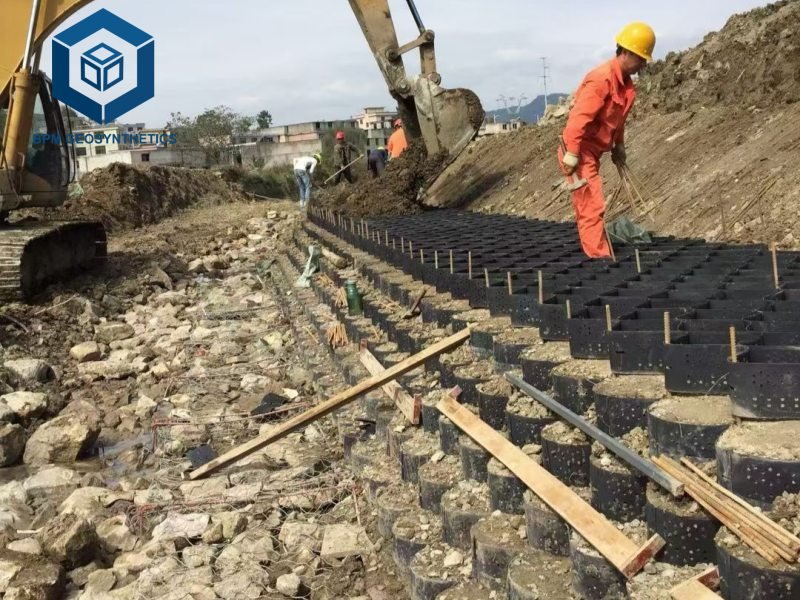
High-Density Polyethylene (HDPE) is specifically recommended for steep slope erosion control. Its primary advantage is flexibility. Steep slopes are rarely perfectly flat; they feature irregular contours and varying gradients. HDPE geocells can be easily expanded and manipulated to “hug” the terrain, ensuring there are no gaps between the geocell and the soil where water could cause sub-surface erosion.
7.2 Support for Sustainable Vegetation
Perforation and Drainage: HDPE geocells are typically manufactured with high perforation rates. This allows for lateral water flow and root penetration, which is essential for “green” slopes.
UV Resistance: Because slope geocells are often partially exposed before vegetation grows, the high UV resistance of carbon-black stabilized HDPE prevents the material from becoming brittle under direct sunlight.
8. What kind of manufacturer warranties or certifications (like ISO or CE) are highlighted in the review?
8.1 International Manufacturers: Certifications and Guarantees
Presto Geosystems (USA): As the pioneer of geocell technology, their GEOWEB series is certified under ISO 9001:2015 and carries the CE mark. Presto emphasizes that its data is validated by third-party laboratories and offers an industry-leading 10-year limited warranty, focusing on weld strength and material consistency.
PRS Geo-Technologies (Israel): Known for its Neoloy high-performance polymeric alloy (NPA) geocells in high-load applications. Their products not only meet ISO standards but specifically highlight ASTM D6992 (SIM) creep testing, promising engineering performance guarantees for up to 75 years under specific geological conditions.
8.2 The Rise of Chinese Manufacturing: BPM Geosynthetics
As a leading Chinese manufacturer, BPM Geosynthetics has established a comprehensive service system that meets international standards.
Comprehensive Certification: BPM’s 26,000-square-meter facility has obtained ISO 9001, ISO 14001, and OHSAS 18001 certifications. Its products are tested by authoritative international bodies such as SGS, Intertek, and BV, ensuring full compliance with ASTM standards.
Warranty Commitment: BPM provides solid quality promises to customers in 100 countries. They typically offer a 2 to 10-year product warranty, specifically covering UV resistance and weld peel strength. This ensures a 99.5% quality qualification rate in highway subgrade and slope stabilization projects.
Summary:
This comprehensive review highlights that optimal geocell selection is dictated by the specific demands of the project environment and structural requirements. While HDPE remains the global versatile choice for erosion control and slope stabilization due to its superior flexibility and UV resistance, Novel Polymeric Alloys (NPA) have emerged as the definitive solution for high-load infrastructure where creep resistance is paramount. Meanwhile, manufacturers like BPM Geosynthetics bridge the gap between high-performance engineering and economic feasibility. By adhering to rigorous international standards such as ISO and ASTM, and offering robust warranty frameworks, these industry leaders ensure that modern confinement systems provide both immediate soil reinforcement and decadal durability in diverse global climates.