Geogrids are robust geosynthetic materials engineered for soil reinforcement, stabilization, and load distribution in civil engineering applications, including road construction, retaining walls, embankments, and landfills. As global infrastructure investments are projected to reach USD 9.5 trillion by 2030, the demand for geogrids is surging, driven by urbanization, sustainable construction practices, and the need for resilient infrastructure. According to Mordor Intelligence, the global geogrid market, valued at USD 1.52 billion in 2025, is expected to grow at a compound annual growth rate (CAGR) of 4.29% to reach USD 1.88 billion by 2030, with road construction accounting for 47% of demand, soil reinforcement for 25%, and railroad stabilization for 15%.
For civil engineers, project managers, contractors, and procurement specialists, understanding geogrid pricing is essential for accurate budgeting and ensuring project longevity. In 2025, geogrid prices typically range from $0.50 to $7.00 per square meter ($0.05 to $0.65 per square foot), excluding installation and ancillary costs. Uniaxial geogrids, suited for high-tensile wall applications, average $0.50–$4.00 per square meter, while biaxial variants for base stabilization command $0.80–$3.50 per square meter. Bulk orders over 10,000 square meters can yield 10–30% discounts, and compliance with standards like ASTM D6637 for tensile properties and ISO 9001 from certified suppliers minimizes failure risks, potentially reducing lifecycle costs by 15–25%.
This comprehensive guide examines geogrid pricing dynamics, drawing on 2025 market data from BPM Geosynthetics, EarthShields, and Made-in-China.com. We explore fundamentals, types, cost influencers, market ranges, selection criteria, calculation methods, installation protocols, trends, and supplier evaluations to provide data-driven recommendations. By applying lifecycle cost analysis, readers can achieve 25–45% improved project efficiency and up to 95% performance reliability, cutting maintenance by 15–30%. Whether reinforcing a highway subgrade or stabilizing a steep slope, this resource delivers the insights needed for strategic decision-making.
1. What Are Geogrids?
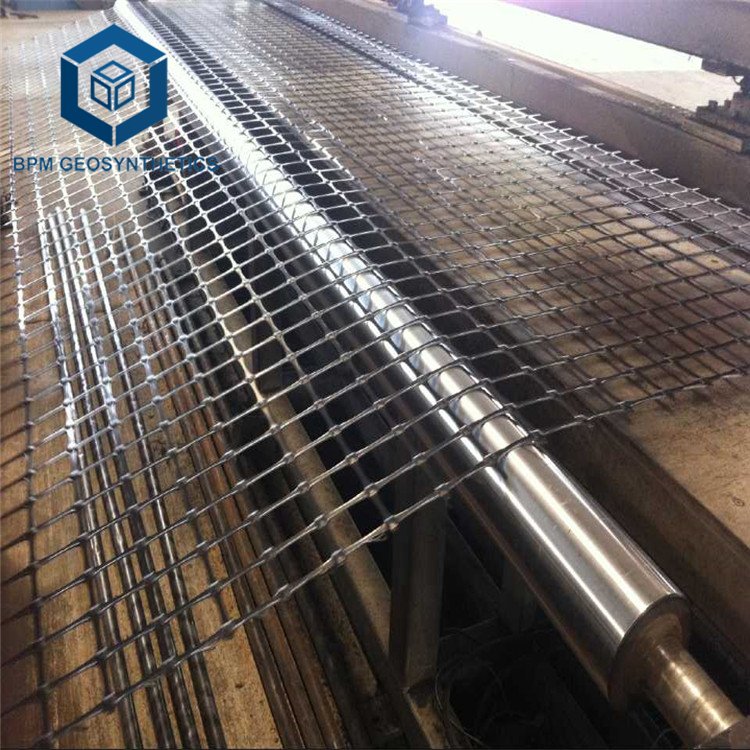
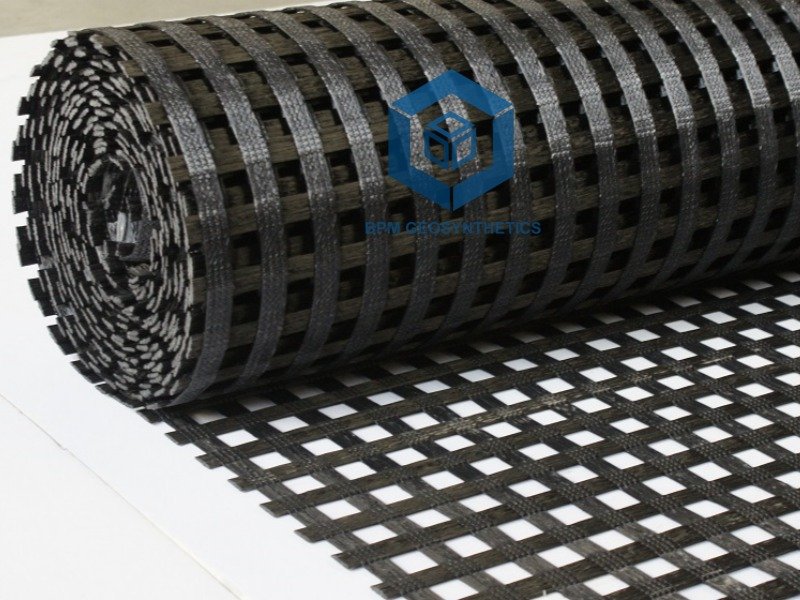
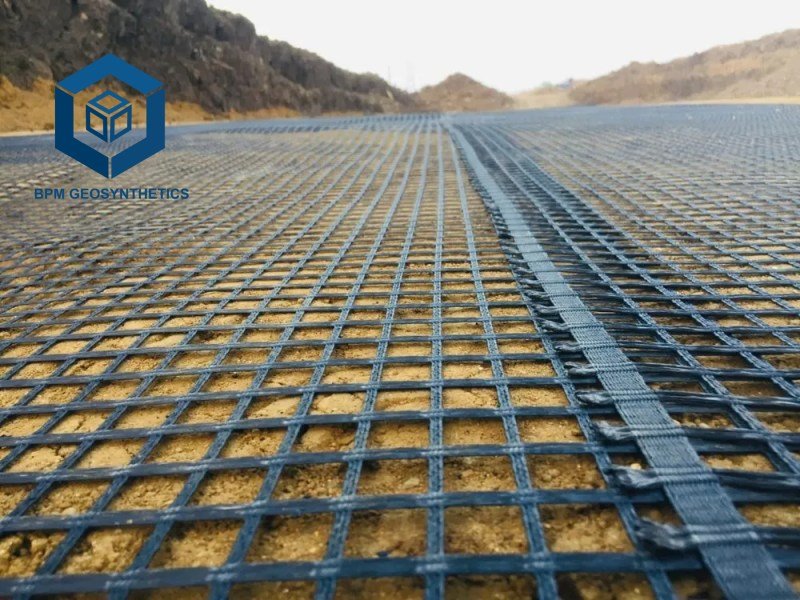
Geogrids are synthetic, open-grid structures designed to interlock with soil or aggregate, enhancing tensile strength and load-bearing capacity in geotechnical applications. Primarily manufactured from polymers like polypropylene (PP), high-density polyethylene (HDPE), or polyester (PET), geogrids provide mechanical stabilization without impeding drainage, distinguishing them from geotextiles or geomembranes.
1.1 Core Functions and Advantages
Geogrids perform three primary functions, validated by ASTM D6637 for tensile strength and ASTM D5262 for junction efficiency:
- Reinforcement: Transfers tensile forces across soil, increasing shear strength by 30–50% and allowing steeper slopes (up to 1:1 ratios) in retaining walls.
- Stabilization: Confines aggregates via aperture interlock, reducing rutting by 40–60% in unpaved roads and extending pavement life by 20–30%.
- Separation: Prevents mixing of subgrade and base layers, minimizing contamination and settlement by 25% in soft soils (CBR <3).
Advantages include 15–25% reductions in aggregate requirements (ASTM D5199), 50–70% erosion control in embankments, and design lifespans of 75–100 years buried (UV-stabilized: 10–20 years exposed). They comply with AASHTO M288 and EU standards, promoting sustainability by cutting excavation by 20% and carbon emissions by 15–30%.
1.2 Evolution and Market Dynamics
Evolving from 1970s extruded plastics to advanced composites with embedded fibers, geogrids now feature smart variants with strain sensors. Asia-Pacific holds 45% market share in 2025, led by China’s USD 1.4 trillion infrastructure push, while North America’s BABA policies boost domestic PET production. Innovations like triaxial designs add 10–20% to costs but improve load distribution by 25%, per Tensar data.
Geogrids are more than grids; they deliver measurable outcomes: 40% enhanced bearing capacity and 95% interlock efficiency.
2. How Much Does a Geogrid Price?
Geogrid pricing in 2025 averages $0.50–$7.00 per square meter, shaped by composition, structure, and volume. Biaxial types (45% market) cost $0.80–$3.50 per square meter for versatile stabilization; uniaxial (30% share) $0.50–$4.00 for directional reinforcement. Specialty triaxial: $1.50–$5.00.
2.1 Geogrid Cost – Material Type
2.1.1 Polypropylene (PP)
PP, 44% market leader, offers chemical resistance (pH 2–13) and affordability. Extruded PP (20–200 kN/m): $0.50–$3.50 per square meter; dominates roads (60% usage). Tensile: 20–100 kN/m; lifespan: 75+ years buried. Example: BPM PP biaxial ($1.20/m²) stabilized a 2024 Indian highway, cutting aggregates by 20%.
2.1.2 High-Density Polyethylene (HDPE)
HDPE provides superior puncture resistance but lower modulus. Costs: $0.60–$2.50 per square meter; tensile: 15–80 kN/m. Ideal for landfills. Example: EarthShields HDPE uniaxial ($1.80/m²) in U.S. waste sites, enhancing stability 35%.
2.1.3 Polyester (PET) and Other Materials
PET excels in creep resistance ($1.00–$4.00/m², 20–300 kN/m); fiberglass ($2.00–$7.00/m²) for high-temperature apps. Steel-plastic hybrids ($3.00–$6.00/m², 50–400 kN/m) suit seismic zones, saving 15% on repairs.
Material | Tensile (kN/m) | Cost ($/m²) | Key Use |
PP Extruded | 20–100 | 0.50–3.50 | Roads |
HDPE | 15–80 | 0.60–2.50 | Landfills |
PET Woven | 20–300 | 1.00–4.00 | Retaining Walls |
2.2 Geogrid Cost – Type and Structure
Structure drives 20–40% of costs: Uniaxial ($0.50–$4.00/m², 20–400 kN/m longitudinal) for walls; biaxial ($0.80–$3.50/m², equal MD/CMD) for bases; triaxial ($1.50–$5.00/m², multi-directional) reduces rutting 50%. Example: TenCate TriAx ($2.50/m²) in airport runways saves 25% on thickness.
2.3 Geogrid Cost – Strength and Aperture Size
Tensile strength (20–1000 kN/m) and aperture (25–65 mm) correlate: Low-strength (20 kN/m, 50 mm aperture) $0.50–$1.50/m²; high (200+ kN/m, 33 mm) $2.00–$7.00/m². Smaller apertures enhance interlock by 20%, adding 10–15%.
2.4 Geogrid Cost – Project Size and Scale
Economies of scale: <1,000 m² premiums 15–20% ($0.70–$8.00/m²); >10,000 m² discounts to $0.40–$5.50/m² (10–30% off). Logistics for 50,000 m²: $0.05–$0.20/m².
2.5 Geogrid Cost – Installation Method and Labor
Installation: 30–50% of total ($0.50–$2.00/m²). Overlaps (300–600 mm): $0.10–$0.30/m²; tensioning: $0.20–$0.50/m². Labor: $10–$50/hour; slopes add 20%.
2.6 Geogrid Cost – Raw Material Quality
Virgin resin (PP $1.20–$1.50/kg) vs. recycled (10–20% cheaper, 5–10% strength loss). Additives (UV/coatings): +5–15% ($0.05–$0.30/m²); oil volatility raised PP 7% in Q1 2025.
2.7 Geogrid Cost – Transportation and Logistics
Shipping: $0.05–$0.20/m²; Asia low ($0.10/m²), Europe high ($0.50/m²). Tariffs add 5–10%; 2025 port issues up North America 5%.
2.8 Geogrid Cost – Maintenance and Lifetime Costs
Lifespan (75–100 years) amortizes $0.005–$0.07/m²/year. Failures add 20–50%; certified cuts by 15% via reduced creep (2–5% strain).
Factor | Cost Impact ($/m²) | Mitigation |
Material (PP vs. PET) | +20–50% for PET | Use PP for non-creep sites |
Strength (20 vs. 200 kN/m) | +50–100% | Match to soil CBR |
Volume (>10k m²) | -10–30% | Bulk procure |
Installation | +30–50% | Train installers |
3. How to Choose the Right Geogrid
Selecting geogrids requires site-specific evaluation for optimal performance and value.
3.1 Assess Project Requirements
Analyze soil (CBR <3: high-strength uniaxial), loads (AASHTO: 50+ kN/m), and hydrology (aperture >25 mm for drainage).
3.2 Prioritize Quality
Choose ISO/ASTM-certified (10–15% premium) for 20% lifecycle savings. Virgin polymers for 100-year designs.
3.3 Evaluate Installation Needs
Flexible woven for curves; rigid extruded for flat bases. Overlap compatibility reduces waste 10%.
3.4 Consider Long-Term Costs
Biodegradable hybrids save 15% in temporary apps; high-modulus cuts maintenance 25%.
3.5 Compare Suppliers
Benchmark BPM ($0.50–$3.00/m²) vs. TenCate ($1.00–$4.00/m²) for 10–15% leverage. Case: BPM uniaxial in 2024 Brazilian wall saved $120,000 via 20% thinner layers.
4. Industry Trends Affecting Geogrid Costs in 2025
- Sustainability Push: Recycled PET up 15–25% cheaper, meeting ESG goals; coir hybrids save $1,000/acre removal.
- Smart Integration: Sensor geogrids +20–50% ($2.00–$10.00/m²), cutting monitoring 15%.
- Material Volatility: PP up 5–7% from oil; long-term contracts hedge.
- Regional Shifts: Asia exports -5% tariffs; U.S./EU +3–7% via BABA.
Triaxial growth 5.24% CAGR; PFAS-free +10% for compliance.
5. Conclusion
Geogrid prices in 2025, from $0.50–$7.00 per square meter, are influenced by material, type, and scale, but smart selection unlocks 10–30% savings and 95% efficacy. Uniaxial ($0.50–$4.00/m²) excels in walls (50% apps), biaxial ($0.80–$3.50/m²) in roads (60%), per ASTM. Total costs (material +30–50% install) require alignment for 30–50% stability gains and 60% rutting reduction.
For quotes and guidance, contact The Best Project Material Co., Ltd (BPM Geosynthetics). Our ISO-certified portfolio ensures 98% reliability.