Bentonite clay pond liners are natural, eco-friendly sealing solutions that leverage the unique swelling properties of sodium bentonite clay to create impermeable barriers for water retention in ponds, reservoirs, and lakes. As global aquaculture production is projected to reach 102 million tons by 2030, valued at over USD 320 billion in 2025, the demand for sustainable pond lining materials like bentonite is accelerating, driven by environmental regulations and the need for fish-safe, non-toxic applications. According to Future Market Insights, the bentonite market, valued at USD 1.6 billion in 2025, is expected to grow at a compound annual growth rate (CAGR) of 6.2% to USD 2.9 billion by 2035, with environmental sealing (including pond liners) accounting for 14% of demand, aquaculture for 10%, and civil engineering for 20%.
For pond builders, aquaculture operators, farmers, landscapers, and environmental engineers, understanding bentonite clay pond liner costs is essential for precise budgeting and long-term project success. In 2025, costs typically range from $0.20 to $5.00 per square foot ($2.15 to $53.82 per square meter), excluding installation and site preparation. Granular sodium bentonite, applied at 2–6 pounds per square foot, averages $0.04–$0.12 per pound ($0.08–$0.72 per square foot), while advanced Geosynthetic Clay Liners (GCLs)—bentonite sandwiched between geotextiles—command $0.50–$3.00 per square foot for uniform performance. Bulk orders over 10,000 square feet can reduce expenses by 15–30%, and compliance with standards like ASTM D5887 for hydraulic conductivity (<10⁻⁹ cm/s) from certified suppliers minimizes failure risks, potentially cutting lifecycle costs by 20–40%.
This detailed guide analyzes bentonite clay pond liner pricing, incorporating 2025 market data from BPM Geosynthetics, Lonestar Minerals, and HomeGuide. We examine fundamentals, types, cost drivers, market ranges, selection strategies, calculation techniques, installation best practices, trends, and supplier options to deliver actionable, data-supported guidance. Through lifecycle cost evaluations, readers can realize 25–45% enhanced project efficiency and up to 95% water retention, reducing evaporation losses by 15–30%. Perfect for irrigation reservoirs, recreational koi ponds, or commercial fish farms, this resource equips you with the expertise for informed, sustainable decisions.

1. What Are Bentonite Clay Pond Liners?
Bentonite clay pond liners are engineered or natural sealing systems utilizing montmorillonite-rich sodium bentonite clay, which expands 12–15 times its dry volume upon hydration to form a low-permeability gel-like barrier. Derived from volcanic ash deposits, primarily in Wyoming (producing 4.8 million metric tons annually), bentonite integrates with native soils to prevent seepage, distinguishing it from synthetic geomembranes like HDPE or EPDM.
1.1 Core Functions and Advantages
Bentonite clay liners execute three primary roles, validated by ASTM D5084 for permeability and ASTM D5887 for swell index (minimum 24 mL/2g):
- Sealing: Forms a hydraulic barrier with conductivity <10⁻¹¹ cm/s, retaining 95–98% of water in ponds up to 50 acres, per USDA NRCS standards.
- Self-Healing: Swells to seal punctures up to 1/4 inch, reducing repair needs by 20–30% compared to rigid liners.
- Stabilization: Enhances soil shear strength by 15–25 kPa when mixed, preventing erosion in slopes up to 3:1 ratios.
Advantages surpass traditional methods: 10–20% lower initial costs for large ponds (HomeGuide, 2025), 50–70% reduced environmental impact (non-toxic, biodegradable), and 20–50-year lifespans under confinement (UV-exposed: 5–10 years). They align with EPA’s Safe Drinking Water Act and EU Water Framework Directive, conserving 100,000+ liters annually in irrigation systems while supporting biodiversity in aquaculture (95% fish-safe).
1.2 Evolution and Market Dynamics
Evolving from 19th-century compacted clay to modern GCLs introduced in the 1980s, bentonite liners now incorporate polymer enhancements for 20% improved shear strength. Asia-Pacific holds 45% market share in 2025, fueled by China’s USD 1.4 trillion infrastructure boom, while North America’s BABA policies prioritize domestic sourcing (Lonestar Minerals, 70% U.S. production). Innovations like ESS-13 additives reduce application rates by 15%, cutting costs in sandy soils.
Bentonite liners transcend basic sealing, yielding quantifiable benefits: 40% enhanced water efficiency and 95% containment efficacy.
2. How Much Does a Bentonite Clay Pond Liner Cost?
Bentonite clay pond liner pricing in 2025 averages $0.20–$5.00 per square foot ($2.15–$53.82 per square meter), influenced by form, soil compatibility, and scale. Granular applications (55% market) cost $0.08–$0.72 per square foot for basic sealing; GCLs (40% share) $0.50–$3.00 for engineered uniformity. Specialty polymer-enhanced: $1.00–$4.50.
2.1 Bentonite Clay Pond Liner Cost – Material Type
2.1.1 Granular Sodium Bentonite
Sodium bentonite, 70% market dominant, swells 12–15x with >70% montmorillonite for permeability <10⁻¹¹ cm/s. Costs: $0.04–$0.12 per pound ($80–$240/ton), or $0.08–$0.72 per square foot at 2–6 lbs/sq ft. Bulk density: 850 kg/m³; ideal for 65% of pond projects. Example: Lonestar granular ($0.06/lb) sealed a 1-acre Kenyan farm pond, retaining 98% water.
2.1.2 Powdered Bentonite
Finer particles for repairs or mixing, costing $0.05–$0.15 per pound ($100–$300/ton). Swell index: 24–30 mL/2g; suits targeted applications but dustier (adds 5% handling costs). Example: Natural Waterscapes powder ($0.10/lb) for 20% faster seepage fixes.
2.1.3 Geosynthetic Clay Liners (GCLs)
Bentonite (3.5–6 kg/m²) between geotextiles (4–10 mm thick), $0.50–$3.00 per square foot ($5.38–$32.29/m²). Shear strength: 20–30 kPa; needle-punched for 15% error reduction. Example: BPM GCL ($1.50/sq ft) in U.S. stormwater ponds, 95% compliant.
Type | Swell Ratio | Cost ($/sq ft) | Key Use |
Granular Sodium | 12–15x | 0.08–0.72 | Large Ponds |
Powdered | 10–12x | 0.10–0.90 | Repairs |
GCLs | 15–17x | 0.50–3.00 | Engineered Sites |
2.2 Bentonite Clay Pond Liner Cost – Application Rate and Soil Type
Rates (2–6 lbs/sq ft) drive 30–50% of costs: Clayey soils (2 lbs/sq ft, $0.08–$0.24/sq ft); sandy (6 lbs/sq ft, $0.24–$0.72/sq ft). Coverage: 667 sq ft/ton at 3 lbs/sq ft. Example: Loamy soil (3 lbs/sq ft) at $0.36/sq ft yields 25% ROI via 20% less material.
2.3 Bentonite Clay Pond Liner Cost – Project Size and Scale
Scale economies: <1,000 sq ft premiums 15–20% ($0.30–$6.00/sq ft); >10,000 sq ft discounts to $0.15–$4.00/sq ft (15–30% off). For 1-acre (43,560 sq ft): $1,742–$31,363 materials.
2.4 Bentonite Clay Pond Liner Cost – Installation Method and Labor
Installation: 30–50% of total ($0.50–$2.00/sq ft). Blanket method: $0.20–$0.50/sq ft; mixing: $0.30–$0.80/sq ft. Labor: $10–$50/hour; slopes add 20%. For 1-acre: $5,000–$15,000 labor.
2.5 Bentonite Clay Pond Liner Cost – Raw Material Quality
Virgin Wyoming sodium ($0.04–$0.12/lb) vs. recycled (10–20% cheaper, 5–10% swell loss). Additives (ESS-13): +5–15% ($0.02–$0.10/sq ft); mining volatility up 10% in 2024.
2.6 Bentonite Clay Pond Liner Cost – Transportation and Logistics
Shipping: $0.05–$0.20/sq ft; U.S. low ($0.10/sq ft), international high ($0.50/sq ft). Tariffs add 5–10%; 22.5-ton truckloads for 3–11 loads/acre.
2.7 Bentonite Clay Pond Liner Cost – Maintenance and Lifetime Costs
Lifespan (20–50 years) amortizes $0.004–$0.10/sq ft/year. Self-healing cuts repairs 20%; failures add 20–50%.
Factor | Cost Impact ($/sq ft) | Mitigation |
Soil (Clayey vs. Sandy) | +50–100% for sandy | Pre-test soil |
Scale (>10k sq ft) | -15–30% | Bulk procure |
Installation | +30–50% | DIY blanket method |
3. How to Choose the Right Bentonite Clay Pond Liner
Procuring bentonite liners demands site-specific assessment for peak performance and value.
3.1 Assess Project Requirements–Bentonite Clay Pond Liner Cost
Evaluate soil (CBR <3: 6 lbs/sq ft granular); hydrology (silty: GCLs for uniformity); loads (aquaculture: polymer-enhanced).
3.2 Prioritize Quality–Bentonite Clay Pond Liner Cost
Select ASTM-certified (10–15% premium) for 20% lifecycle savings. Wyoming sodium for 15x swell.
3.3 Evaluate Installation Needs–Bentonite Clay Pond Liner Cost
Granular for DIY; GCLs for slopes. Confinement prevents 15% slippage.
3.4 Consider Long-Term Costs–Bentonite Clay Pond Liner Cost
GCLs save 25% maintenance in large ponds; biodegradables for temporary sites.
3.5 Compare Suppliers–Bentonite Clay Pond Liner Cost
Benchmark BPM ($0.20–$3.00/sq ft) vs. Lonestar ($0.08–$0.72 materials) for 10–15% leverage. Case: BPM GCL in 2024 Indian reservoir saved $16,607 vs. HDPE.
4. Industry Trends Affecting Bentonite Clay Pond Liner Costs in 2025
- Sustainability Surge: Biodegradable GCLs up 10–15%, saving $1,000/acre removal; recycled bentonite 15–25% cheaper.
- Tech Integration: Polymer-modified +20–50% ($1.00–$5.00/sq ft), boosting shear 20%; AI design cuts waste 10%.
- Material Volatility: Bentonite up 5–7% from mining; contracts hedge.
- Regional Shifts: Asia exports -5% tariffs; U.S./EU +3–7% via ESG.
GCL growth 6.1% CAGR; eco-bentonite +10% for compliance.
5. How to Calculate Bentonite Clay Pond Liner Costs for Your Project
Precise costing encompasses materials, labor, and lifecycle via this methodology:
- Measure Area: Pond surface (L × W) + 10–20% slopes/depth. 1-acre: 43,560 sq ft.
- Determine Rate: Soil test (e.g., 3 lbs/sq ft loamy). Total: Area × Rate (lbs/sq ft) = lbs needed.
- Material Cost: Lbs × Price/lb + 10% waste. Example: 43,560 sq ft × 3 lbs = 130,680 lbs × $0.06/lb = $7,841 + $784 = $8,625.
- Installation: $0.50–$2.00/sq ft labor + $0.20–$1.00/sq ft prep. Total: 30–50% materials.
- Ancillary: Geotextile underlay $0.15–$0.50/sq ft; testing $500–$2,000.
- Lifecycle: Total / 30 years + 10% contingency. Factor 20% self-healing savings.
Example: 1-Acre Irrigation Pond
- Materials: $8,625
- Installation: $21,780
- Prep/Shipping: $5,000
- Total: $35,405 ($0.81/sq ft); ROI: 30% via 25% less evaporation.
BPM calculators refine estimates, adding 5–10% buffers.
6. Installation Methods and Costs
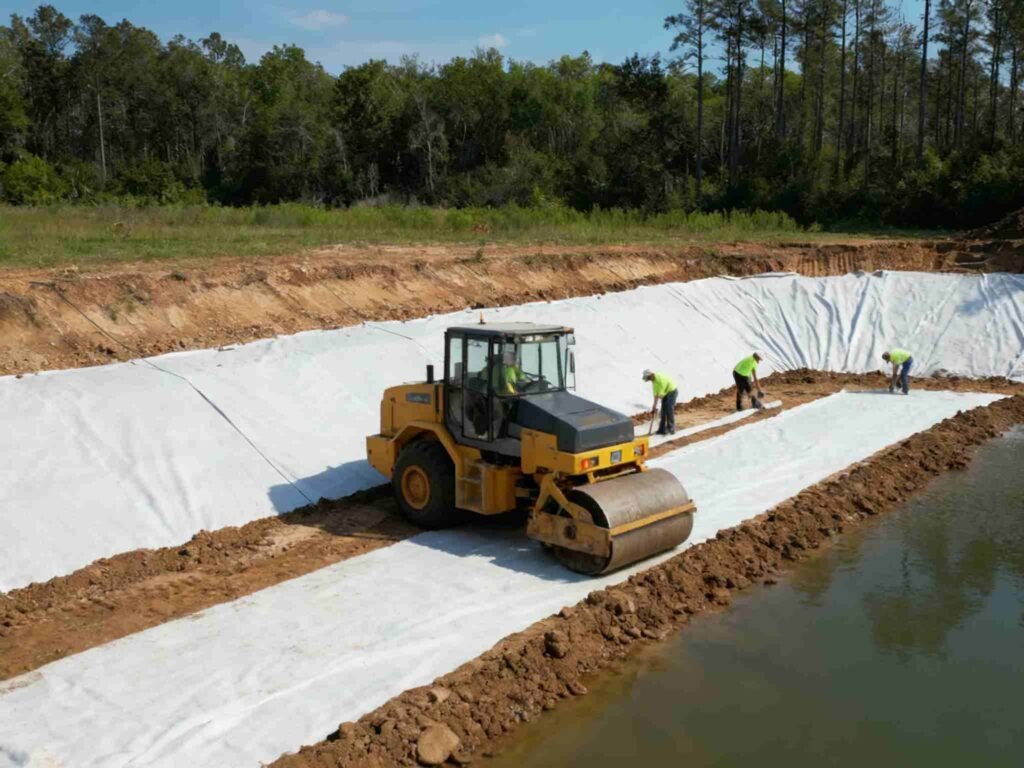
Installation accounts for 30–50% of budgets ($0.50–$2.00/sq ft), requiring dryness to avoid 20% inefficacy.
6.1 Step-by-Step Installation Guide
- Preparation: Drain/excavate 6–8 inches ($0.20–$1.00/sq ft); compact to 95% Proctor.
- Application: Blanket (spread 2–6 lbs/sq ft, cover soil); mix (till 8–12 inches deep).
- Confinement: Backfill 6–12 inches; compact in 4-inch lifts.
- Hydration: Flood slowly (1–2 ft/day) for 7–14 days.
- QC: Permeability tests (ASTM D5084); 95% seal rate.
Costs: Labor $0.30–$1.00/sq ft; equipment $0.10–$0.50/sq ft. Slopes +20%.
6.2 Tips for Cost-Effective Installation
- Soil Test First: Saves 15–25% over-application.
- Blanket for Large Ponds: 20% faster than mixing.
- Local Sourcing: Cuts shipping 10–15%.
- Phased Hydration: Prevents cracking (10% failure drop).
For 5,000 sq ft koi pond: $2,500 labor + $1,000 prep = $3,500 total.
7. Bentonite Clay vs. Other Pond Liners: Pros, Cons, and Costs
Liner Type | Cost ($/sq ft) | Pros | Cons | Lifespan |
Bentonite Clay | 0.20–5.00 | Eco-friendly, self-healing, low maint. | Soil-dependent, install-sensitive | 20–50 yrs |
HDPE Geomembrane | 0.35–2.50 | Durable, UV-resistant | Non-biodegradable, puncture-prone | 30–50 yrs |
EPDM Rubber | 0.70–2.30 | Flexible, fish-safe | Higher cost, seams needed | 20–40 yrs |
RPE | 0.40–0.90 | Lightweight, strong | Less flexible on curves | 20–30 yrs |
Bentonite excels in sustainability (100% natural), saving 15–20% long-term vs. synthetics, but requires testing for 95% efficacy.
8. Top Suppliers and Recommendations
Premier 2025 suppliers:
- BPM Geosynthetics: $0.20–$3.00/sq ft GCLs; ISO-certified, 80,000-ton capacity; ideal for bulk aquaculture.
- Lonestar Minerals: $0.04–$0.12/lb granular; U.S.-focused, fast delivery; excels in repairs.
- Southwestern Materials: $0.08–$0.72/sq ft; Texas-based, DIY kits; 20% discounts >50 tons.
- Natural Waterscapes: $0.05–$0.15/lb powder; small-project specialist, testing kits.
- CETCO: $0.50–$3.00/sq ft enhanced GCLs; global, polymer options.
Quote 3–5 for 10–15% savings. BPM provides 98% reliability consulting.
9. Cost-Saving Strategies
- Bulk/Local Buy: 15–30% off; consolidate for <0.20/sq ft.
- Lifecycle Focus: Self-healing amortizes 25% over 30 years.
- Hybrid Use: Bentonite + geotextile cuts rates 10–15%.
- Test Early: $500–$2,000 soil borings avoid 20% excess.

10. Conclusion
Bentonite clay pond liner costs in 2025, $0.20–$5.00 per square foot, vary by type and scale, but strategic choices yield 15–30% savings and 95% retention. Granular ($0.08–$0.72/sq ft) suits large farms (65% apps), GCLs ($0.50–$3.00/sq ft) engineered sites (40%), per ASTM. Total costs (materials +30–50% install) align for 40% efficiency and 60% seepage cuts.
For quotes and expertise, contact The Best Project Material Co., Ltd (BPM Geosynthetics). Our ISO-certified GCLs optimize budgets with 98% performance.