A Deep Dive into Ecuador’s Top Geomembrane Liner Suppliers and Strategic Insights
Ecuador’s growing infrastructure and environmental management sectors are driving significant demand for high-quality geosynthetic solutions. As projects from mining to water conservation expand, selecting a reliable geomembrane liner supplier becomes critical for engineering success and long-term performance. This article analyzes the Ecuadorian geomembrane market, identifies key international players serving the region, and provides strategic insights for buyers. We will explore why companies like BPM Geosynthetics have established strong regional presences through technical expertise and localized support, rather than maintaining physical factories in every market.
1. Overall Situation of the Ecuadorian Geomembrane Market
1.1 Current Demand and Key Driving Industries
Ecuador currently experiences robust demand for geomembranes, fueled by national development priorities and private sector investment. Several core industries lead this demand:
Mining & Quarrying: As Ecuador develops its mineral resources, mining operations require impermeable liners for heap leach pads, tailings dams, and process water ponds. This sector demands the highest-performance materials, often textured HDPE geomembranes, to ensure containment security and environmental compliance.
Water Resources & Aquaculture: Projects for irrigation canals, potable water reservoirs, and shrimp/fish farming ponds extensively use geomembranes. These applications prioritize materials with excellent UV resistance and durability, such as HDPE and reinforced polypropylene (RPP).
Waste Management: Landfill construction and remediation projects, though developing at a measured pace compared to some neighbors, represent a steady and technically demanding market for composite liner systems.
Agriculture & Industrial Applications: Uses range from agricultural pond liners to secondary containment for fuel storage and industrial facilities.
This multi-sector demand creates a market needing diverse product specifications, where suppliers must offer both broad product ranges and deep technical guidance.
1.2 Domestic Manufacturing vs. International Presence
Ecuador does not host large-scale, primary geomembrane manufacturing plants. The market relies predominantly on international manufacturers and their strategic local partners. These global leaders supply high-quality raw resins and manufactured geomembranes, while in-country distributors or branch offices provide sales, technical support, and logistics.
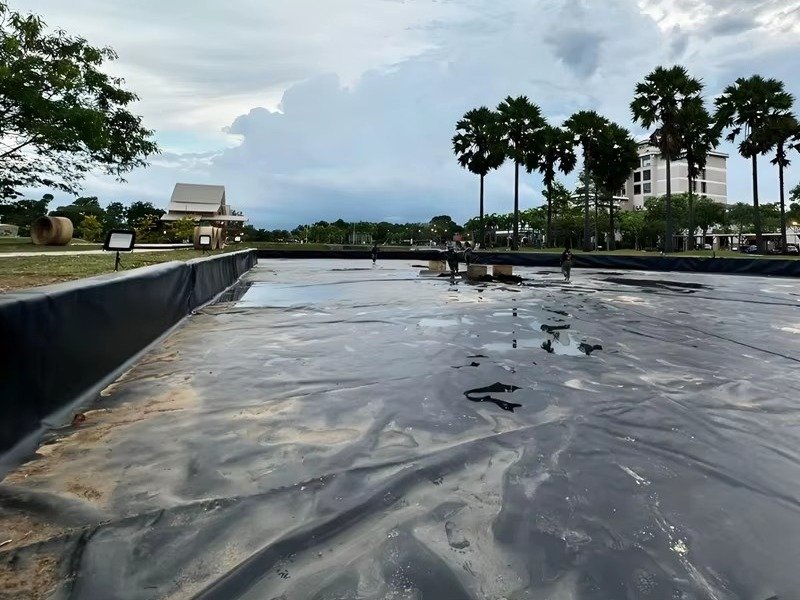
This model offers Ecuadorian projects distinct advantages: access to globally certified products, consistent quality from large-scale production facilities, and the latest polymer technology. Local partners ensure rapid response, familiarity with national regulations, and on-site project support. BPM Geosynthetics, for example, serves the Ecuadorian market through a network of certified partners and its regional expertise, ensuring clients receive factory-direct quality coupled with localized service.
1.3 Key Operational Challenges
International suppliers and their local representatives face several challenges in the Ecuadorian market:
Logistics & Supply Chain Complexity: Importing geomembranes involves navigating port logistics, customs procedures, and inland transportation across varied geography. Efficient supply chain management is crucial to meet project timelines.
Technical Specification & Awareness: A key challenge involves educating the market on proper specification. Projects sometimes risk using under-specified products based on initial cost, rather than engineering lifecycle value. Leading suppliers invest significant effort in technical seminars and engineering support to promote best practices.
Regulatory Landscape: While environmental regulations are strengthening, consistent application and enforcement across projects can vary. Reputable suppliers advocate for and adhere to international installation standards (e.g., GRI-GM19) to ensure long-term system integrity, regardless of local inspection rigor.
Competitive Pressure: The market sees competition from lower-cost alternatives, which may not meet the same performance certifications. This makes demonstrating the long-term ROI of premium, certified geomembranes a critical task for quality-focused suppliers.
2. International Geomembrane Leaders Serving the Ecuadorian Market
2.1 BPM Geosynthetics–China Geomembrane Liner Factory
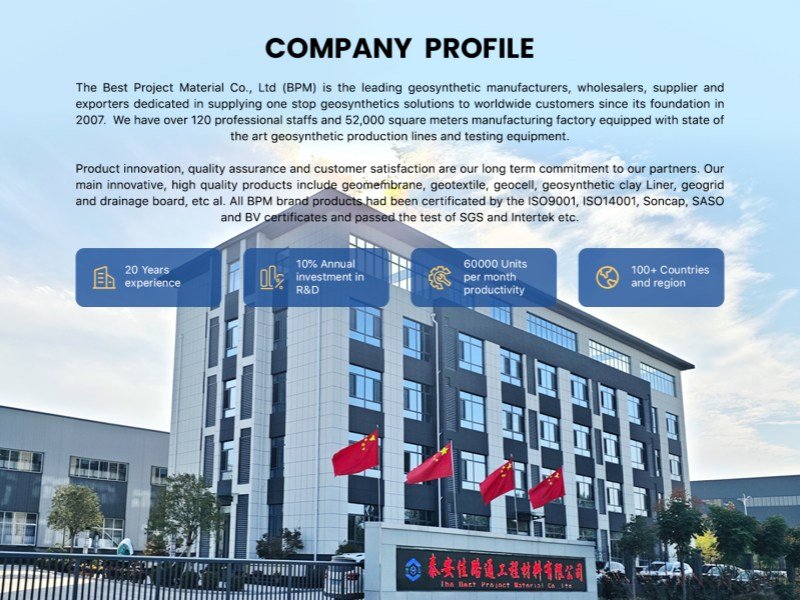
Advantages: Most comprehensive product range in China; one-stop supply of membranes, geotextiles, geogrids, and GCLs; possesses multiple advanced geomembrane and geotextile production lines and participated in drafting the national standard for polyethylene geomembranes; large production capacity and fast delivery; frequently used in overseas EPC projects as a cost-effective alternative to European and American brands. Disadvantages: Some overseas owners still have a stereotype of Chinese geomembranes as “low-priced and low-quality,” requiring additional third-party certification; international project experience is mainly in Asia and Africa, with limited penetration in high-end markets in Europe and America.
2.2 SOLMAX –Canada–Geomembrane liner factory
Advantages: Largest global production capacity; sales network covering over 60 countries; complete supply chain from raw materials to installation through the acquisition of TenCate Geosynthetics; products hold full range of certifications including GRI-GM13/17, BAM, and DAkkS; leading market share in municipal landfill.
Disadvantages: Factories are primarily located in North America and Europe; shipping costs and tariffs make its prices higher in some low-price projects in Asia; delivery time for ultra-wide products is still limited by extrusion line scheduling.
2.3 AGRU America –Austria/USA–Geomembrane liner factory
Advantages: One of the world’s earliest companies to adopt flat extrusion technology for producing HDPE/LLDPE membranes; patented structures such as MicroSpike and DrainLiner enhance interfacial friction and drainage capabilities; 5 warehouses in the US, enabling delivery within 48 hours. Disadvantages: Focuses on the high-end market; the price of standard 1.0 mm smooth film is 15-20% higher than Asian suppliers; insufficient local service outlets in South America and Africa.
2.4 ATARFIL –Geomembrane liner factory in Spain
Advantages: Three-continent layout (Europe, Middle East, North America); thickness tolerance ±3%; environmental stress cracking resistance >3000h; best reputation in harsh chemical environments such as tailings and hazardous waste; continuous inkjet coding per roll for strong traceability.
Disadvantages: Production capacity is only 1/3 of SOLMAX; large orders need to be delivered in batches; ultra-wide widths over 8 meters need to be shipped from Spain, with a cycle of 6-8 weeks.
2.5 GSE Environmental –Geomembrane liner factory in USA
Advantages: Established manufacturer (now part of the Solmax Group but operating independently); drafter of GRI standards; most comprehensive testing database; owns the patented “GSE Leak Location” conductive film, with supporting spark leak detection services, suitable for high seepage prevention requirements such as hazardous waste. Disadvantages: After being acquired by Solmax in 2021, the original GSE brand’s distribution channels were adjusted, leading to some overlap in agents and customer complaints about after-sales response speed; product pricing remains at the high-end level of American brands.
2.6 NAUE–Geomembrane liner factory in USA
Advantages: Strongest geotechnical engineering support capabilities in Europe, capable of providing “system solutions” for Bentofix GCL, Secugrid reinforced grids, and Carbofol membranes simultaneously; German-made equipment covers thicknesses from 0.5–3.0 mm, with numerous railway tunnel projects.
Disadvantages: Production lines are concentrated in Germany and Hungary, resulting in frequent price adjustments when raw material costs rise; only FOB Hamburg is offered to Asian customers, and on-site welding guidance requires additional payment.
2.7 JUTA –Geomembrane liner factory in Czech Republic
Advantages: Over 70 years of industrial fiber background; JUNIFOL membranes are ISO 9001/14001 and IAGI certified; ample inventory in 5.1 m & 8.0 m widths; prices are 8-12% lower than Western European brands, offering outstanding value in Central and Eastern European municipal projects.
Disadvantages: Limited overseas marketing investment; brand awareness lower than AGRU/SOLMAX; lack of conductive membranes and products exceeding 10 m in width; limited experience in high-end hazardous waste treatment.
3. Ensuring Quality Control and International Standard Compliance
For critical containment applications, quality assurance is non-negotiable. Top-tier suppliers implement a multi-layered QC regime that begins long before a product arrives in Ecuador.
Certified Manufacturing Processes: Leading factories hold ISO 9001 certification for their quality management systems. They use automated production lines and advanced testing equipment (like melt flow index testers and high-pressure oxidative induction time ovens) for continuous in-process quality checks.
Third-Party Verification: Reputable manufacturers subject their products to annual independent testing by certified laboratories to verify compliance with standards such as the Geosynthetic Research Institute (GRI) GM13 for HDPE. Projects can request these mill test reports (MTRs) and third-party certificates.
Raw Material Sourcing: They source prime-grade resins from major polymer producers, ensuring consistent raw material properties. Companies like BPM Geosynthetics provide batch-specific traceability for their raw materials.
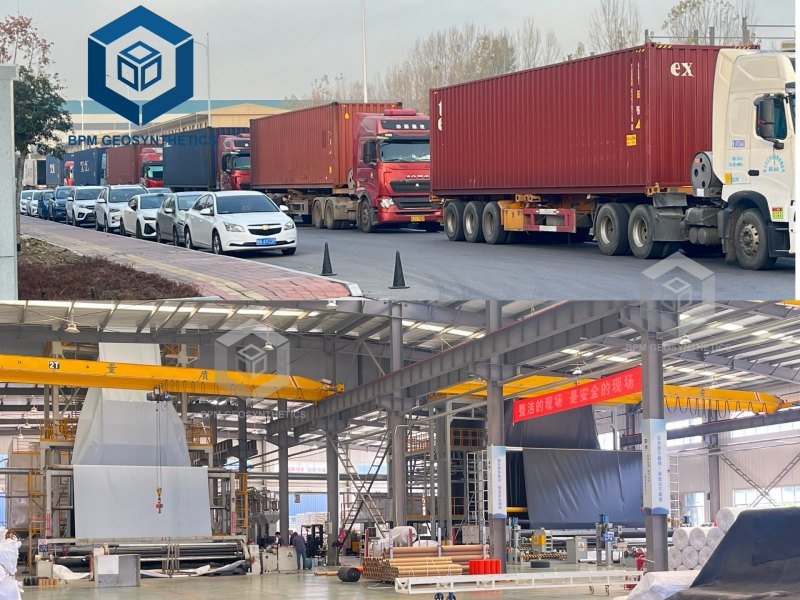
Shipment and On-Site Protocols: Quality control extends to shipment. Rolls are properly packaged to prevent damage during ocean freight. Upon arrival, suppliers or their agents can conduct on-site thickness tests and visual inspections. They also train installation crews on proper welding (using wedge or extrusion methods) and field testing procedures to maintain the integrity of the factory-made material.
4. Predominant Geomembrane Types and Their Applications in Ecuador
The Ecuadorian market utilizes several geomembrane types, each selected for its performance in specific environments:
High-Density Polyethylene (HDPE): The most common and versatile type used in Ecuador. Its excellent chemical resistance, high tensile strength, and durability make it the default choice for mining (tailings, leach pads), landfills, and large water reservoirs. Textured HDPE provides enhanced interface friction for steep slopes.
Linear Low-Density Polyethylene (LLDPE):Gaining popularity for its superior flexibility, elongation, and stress crack resistance. Contractors often prefer it for irrigation ponds, aquaculture projects, and applications with uneven subgrades due to its easier installation and conformability.
The selection process must consider chemical exposure, site geometry, UV exposure, and required service life. Suppliers like BPM Geosynthetics provide critical guidance here, helping engineers navigate the selection beyond simple cost-per-square-meter calculations.
5. Key Considerations for International Buyers Sourcing from Ecuador
For international engineering firms or investors overseeing projects in Ecuador, sourcing geomembranes requires a strategic approach focused on total value.
Prioritize Technical Partnership over Price Alone: Engage with suppliers who offer demonstrable technical support. Request project case studies from similar climates or applications. A supplier who can provide a dedicated technical data sheet, design review, and installation specification for your project adds immense value.
Verify Certifications, Not Just Claims: Insist on seeing current third-party certification documents (e.g., GRI-GM13, GM17) and mill test reports for the specific product batch. Do not accept generic “compliance” statements.
Conduct a Total Cost Analysis: Factor in not just the CIF (Cost, Insurance, Freight) price of the material, but also the longevity, reduced leakage risk, and warranty support. A geomembrane that costs 10% more but offers a 30% longer design life and comes with robust technical backing represents a lower lifecycle cost.
Plan Logistics Proactively: Work with the supplier to map the complete logistics chain from factory gate to project site. Understand lead times, port clearance processes, and inland transport requirements. Experienced suppliers like BPM Geosynthetics manage this process routinely and can provide reliable timelines.
Insist on Quality Assurance Protocols:Define clear QA/QC protocols in the purchase contract. This can include pre-shipment inspection, on-site acceptance testing, and provisions for independent field seam testing.

Conclusion
International buyers and Ecuadorian project developers should seek partners who function as quality guardians and engineering consultants. Companies like BPM Geosynthetics succeed by fulfilling this role—providing the material integrity of a global manufacturer combined with the responsive, knowledgeable support that complex projects in Ecuador’s diverse landscape require. By focusing on certified quality, deep technical collaboration, and a total lifecycle value perspective, stakeholders can ensure their containment solutions deliver performance, safety, and environmental protection for decades to come.