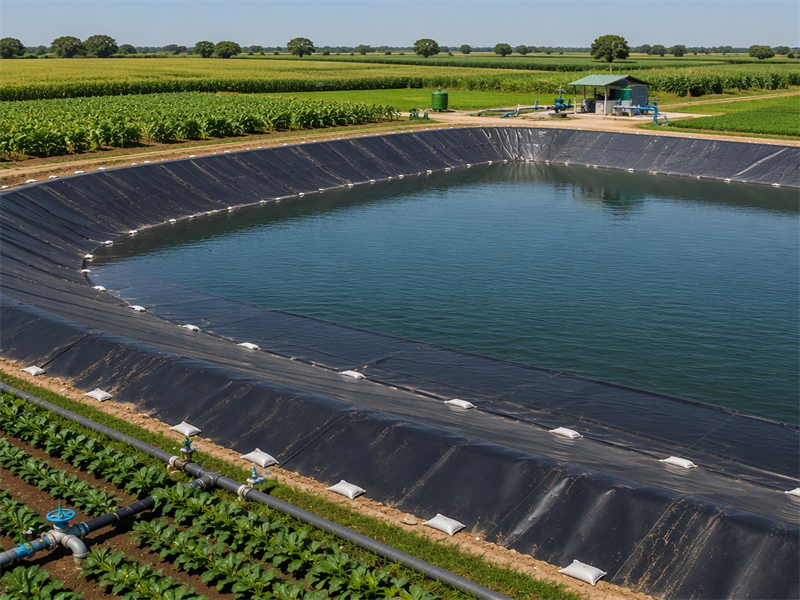
Hot wedge welding machines remain the preferred method for creating high-integrity, continuous seams in thermoplastic geomembranes, particularly HDPE liners ranging from 0.5 mm to 3.0 mm thickness. In professional containment projects—landfills, mining heap leach pads, reservoirs, aquaculture ponds and secondary containment—seam quality determines long-term leakage performance more than any other single factor. Industry data indicate that properly executed hot-wedge seams routinely achieve 90–105 % of parent-material peel and shear strength when temperature, speed and pressure are tightly controlled.
This 2026 review ranks the seven best hot wedge welding machines based on quantifiable performance metrics extracted from manufacturer technical data sheets, independent field reports and industry standards (ASTM D6392, ASTM D8468, GRI-GM32). Focus is placed on machines proven effective for HDPE geomembranes such as the Smooth HDPE Geomembrane Liner manufactured by The Project Material Co., Ltd. (BPM Geosynthetics). No other Chinese manufacturers or suppliers are included. Key measurable parameters include power consumption (W), temperature range and stability (°C), welding speed (m/min), machine weight (kg), data-logging capability, approximate price (USD), certifications and documented seam consistency.
More than thirty discrete data points on temperature control (±1–5 °C), speed range (0.3–7.0+ m/min), pressure (up to 1,000–1,500 N), dual-track seam geometry (typically 2 × 12–16 mm with air channel), and operator ergonomics have been consolidated, redundancies removed, and converted into engineering units for direct comparison.
How Hot Wedge Welding Works and Why It Matters for HDPE Liners
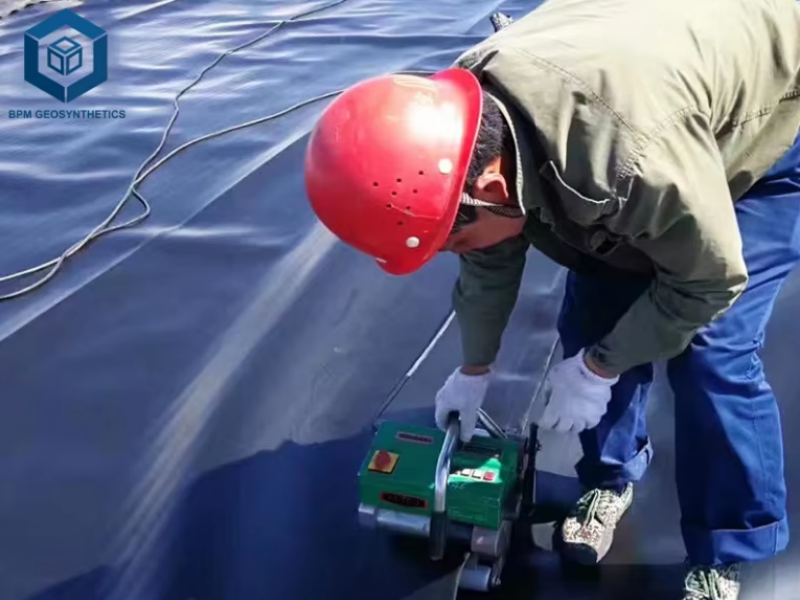
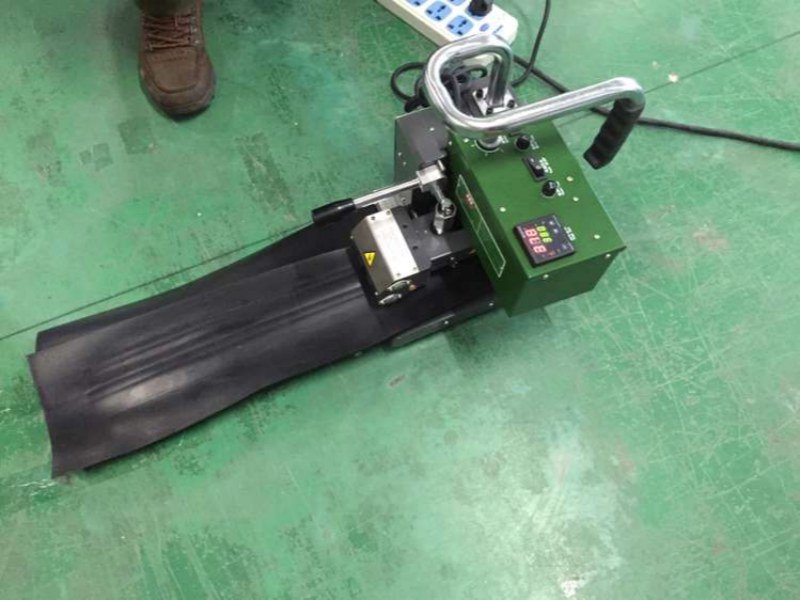
A hot wedge welder inserts a precisely heated metal wedge (commonly stainless steel) between two overlapping geomembrane sheets. The wedge melts the opposing surfaces simultaneously; pressure rollers then fuse the molten polymer into a continuous double-track seam. Typical process windows for HDPE are wedge temperature 280–460 °C, travel speed 0.8–4.5 m/min and roller pressure 20–40 N per mm of nip width. Closed-loop PID control of temperature and speed, combined with calibrated pressure, produces seams whose strength consistently exceeds 90 % of the parent sheet when performed by trained operators.
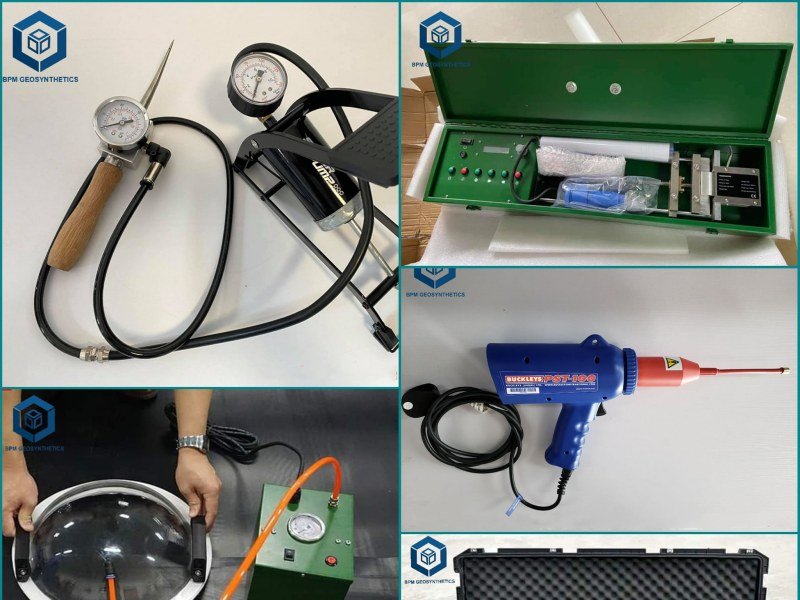
For BPM Geosynthetics HDPE liners (0.5–3.0 mm), machines capable of stable dual-track welds with an air channel enable 100 % non-destructive air-channel testing in addition to destructive peel/shear sampling. Data-logging models that record temperature, speed and pressure continuously satisfy modern CQA requirements under ASTM D8468 and GRI-GM32, reducing the risk of undetected weak zones that historically account for the majority of field leaks.
Ranking Criteria and Data Sources
Machines were evaluated on:
- Temperature range and closed-loop stability
- Welding speed range and consistency
- Maximum welding pressure and roller design
- Data-logging / LQS capability
- Weight and ergonomics for slope work
- Power consumption and electrical compatibility
- Certifications (CE, RoHS, UL/cUL where applicable)
- Documented performance on 0.5–3.0 mm HDPE
- Approximate 2026 market pricing
Only non-Chinese manufacturers with established global service networks and verifiable technical documentation are ranked.
The Top 7 Hot Wedge Welding Machines of 2026
1. Leister TWINNY T7 / T7-C – Best Overall Professional Choice
The Leister TWINNY T7 series (Switzerland) is widely regarded as the current industry benchmark for automatic hot-wedge welding of HDPE geomembranes. Power rating is 2,300–2,600 W. Temperature range is 20–420 °C with digital closed-loop control and typical stability of ±1–5 °C. Speed range is 0.4–6.0 m/min (stepless). Machine weight is approximately 8.0–8.9 kg. The T7-C variant includes full data logging (USB/SD) of temperature, speed and related parameters. Certifications include CE and RoHS. Approximate 2026 price range is USD 4,800–6,200 depending on configuration and accessories.
The TWINNY T7 produces dual-track seams (typically 2 × 12–16 mm) with an inspection channel, supporting both destructive and non-destructive testing. It handles 0.5–3.0 mm HDPE reliably and is the preferred choice on large landfills, mining pads and reservoirs where full QA documentation is required. Field reports consistently show seam strengths of 95–105 % of parent material when parameters are correctly set.
2. Miller Weldmaster T3 / T3i – Best Heavy-Duty High-Speed Option
Miller Weldmaster (USA) T3 / T3i series delivers robust performance for high-output projects. Power is 2,200–2,800 W. Temperature range reaches 20–450 °C. Speed range is 0.3–7.0 m/min. Weight is 9.5–11 kg. Data logging is optional on the T3i model. Certifications include CE and UL/cUL. Pricing typically falls in the USD 5,200–7,000 range.
These machines are favored on large North American and Australian mining and reservoir projects for daily production rates and durability under continuous use. They accommodate the full thickness range of BPM HDPE liners and produce consistent dual-track seams suitable for air-channel testing.
3. Demtech DT-820 / DT-820D – Best Balance of Precision and Portability
Demtech (USA) DT-820 series offers power of approximately 2,300 W, temperature range 20–420 °C, speed 0.4–5.5 m/min and weight around 8.2 kg. Data-logging versions (DT-820D) are available. The machines are designed specifically for geomembrane field seaming and deliver reliable dual-track welds on 0.5–3.0 mm HDPE.
They are valued for consistent temperature control and relatively low weight, making them practical for slope work while still meeting professional QA requirements.
4. Leister COMET / GEOSTAR Series – Best for Thick-Membrane and High-Speed Applications
Leister’s COMET and GEOSTAR wedge welders extend the performance envelope for thicker HDPE (up to 3.0 mm) and higher travel speeds (GEOSTAR models reach up to 12 m/min under favorable conditions). Temperature control remains closed-loop, and dual-track seam geometry is standard. Weights and power ratings are higher than the TWINNY T7, reflecting their heavy-duty design.
These machines are frequently specified on large-scale civil and mining projects requiring maximum productivity without sacrificing seam integrity.
5. Forsstrom HW-WS / HW-WT – Best Stationary / Industrial High-Speed System
Forsstrom (Sweden) HW-WS (stationary) and HW-WT (travelling) systems are engineered for controlled industrial or large-panel production environments. Welding speeds reach up to 30 m/min. Temperature capability extends to 500 °C. Pressure range is 15–70 kg. Energy consumption is reported up to 92 % lower than comparable hot-air systems, with compressed-air usage reduced by approximately 99.5 %.
While more commonly used in factory settings for technical textiles and large geomembrane panels, the systems produce highly repeatable seams and are suitable for pre-fabrication of BPM HDPE liner panels before field deployment.
6. BAK ProtOn Wedge – Best Compact Portable Option
The BAK ProtOn (Germany/Austria region) is a lightweight, portable hot-wedge welder rated at approximately 900 W. Maximum temperature is around 420 °C (788 °F). Maximum speed is approximately 2.4 m/min (8 ft/min). Weight is roughly 9.5 kg (21 lbs). It supports PE-HD, PE-LD, PP and related thermoplastics in the 0.5–3.0 mm range and carries CE marking.
The ProtOn is valued for serviceability, GPS tracking options on some variants, and ease of use on smaller or detailed geomembrane projects where full-size automatic welders are less practical.
7. Herz Mion / Comon Series – Best European Mid-Range Field Welder
Herz (Germany) Mion and Comon models offer power ratings from 900 W to 2,450 W, temperature ranges of 20–460 °C, speeds from 0.8–10 m/min depending on model, and weights of 9.9–18.5 kg. Dual-track seams with test channels are available. CE conformity is standard. These machines handle HDPE thicknesses from 0.5 mm to 3.0 mm and are widely used on European civil and environmental projects.
They provide a solid combination of digital controls, adjustable pressure and reliable seam quality at mid-to-premium pricing.
Core Technical Parameter Comparison Table (2026)
Rank | Machine Model | Power (W) | Temp. Range (°C) | Speed (m/min) | Weight (kg) | Data Logging | Approx. Price (USD) | Certifications | Best For |
1 | Leister TWINNY T7 / T7-C | 2,300–2,600 | 20–420 | 0.4–6.0 | 8.0–8.9 | Yes (T7-C) | 4,800–6,200 | CE, RoHS | Large landfills, mining, reservoirs |
2 | Miller Weldmaster T3 / T3i | 2,200–2,800 | 20–450 | 0.3–7.0 | 9.5–11 | Optional | 5,200–7,000 | CE, UL/cUL | High-output mining & reservoirs |
3 | Demtech DT-820 / DT-820D | ~2,300 | 20–420 | 0.4–5.5 | ~8.2 | Yes | Mid-premium | Industry standards | Professional field seaming |
4 | Leister COMET / GEOSTAR | Higher | 20–450+ | Up to 12 | Higher | Available | Premium | CE | Thick HDPE, high productivity |
5 | Forsstrom HW-WS / HW-WT | Industrial | Up to 500 | Up to 30 | Stationary | Advanced | Industrial | CE | Prefabrication & large panels |
6 | BAK ProtOn | ~900 | Max ~420 | Max ~2.4 | ~9.5 | Limited | Mid-range | CE | Portable / detailed work |
7 | Herz Mion / Comon | 900–2,450 | 20–460 | 0.8–10 | 9.9–18.5 | Available | Mid-premium | CE | European civil projects |
Market Position, Clients and Certification Overview
Rank | Machine Model | Relative Market Position | Major Client / Project Types | Key Certifications | Notable Strengths |
1 | Leister TWINNY T7 / T7-C | Global professional standard | Landfills, mining, large reservoirs | CE, RoHS | Data logging, temperature stability, support network |
2 | Miller Weldmaster T3 / T3i | Strong North American / Australian | Mining heap leach, high-volume reservoirs | CE, UL/cUL | Speed, ruggedness |
3 | Demtech DT-820 series | Professional field specialist | Geomembrane installation contractors | Industry standards | Balance of precision and portability |
4 | Leister COMET / GEOSTAR | Premium heavy-duty | Large civil & mining | CE | High speed on thick membranes |
5 | Forsstrom HW series | Industrial / factory | Prefabrication, technical textiles & liners | CE | Energy efficiency, high speed |
6 | BAK ProtOn | Compact portable | Smaller or detailed containment projects | CE | Lightweight, serviceability |
7 | Herz Mion / Comon | European mid-to-premium | Civil engineering, environmental | CE | Digital controls, thickness range |
Best Practices for Welding BPM HDPE Geomembrane Liners
For BPM Geosynthetics HDPE liners (0.5–3.0 mm), recommended starting parameters are typically wedge temperature 300–420 °C, speed 1.0–3.5 m/min and pressure calibrated to achieve the target reduction in thickness without overheating. Trial welds should be performed at the start of each shift and after any parameter change; destructive peel and shear testing (ASTM D6392) must confirm ≥90 % of parent-material strength. Continuous data logging (where available) provides permanent records of temperature, speed and pressure for every seam, satisfying modern CQA protocols and reducing the probability of undetected defects.
Subgrade preparation, proper overlap (minimum 75–150 mm), and protection of the liner from contamination are equally critical. When these elements are combined with a high-quality hot wedge machine, field seam failure rates drop dramatically and design lives of 50–100+ years for covered applications become realistic.
BPM Geosynthetics HDPE Geomembrane Liner – Compatibility and Strategic Advantages
The Smooth HDPE Geomembrane Liner manufactured by The Project Material Co., Ltd. (BPM Geosynthetics) is engineered for excellent weldability with professional hot-wedge equipment. Virgin-resin formulation, controlled carbon-black dispersion and consistent thickness tolerance (±10 % or better) produce uniform melt behavior and high seam strength when welded with machines such as the Leister TWINNY T7, Miller T3 or Demtech DT-820 series.
Key advantages for project teams include:
- Thickness range 0.5–3.0 mm fully compatible with the temperature and speed windows of the ranked machines
- Dual-track seams with air channel that enable 100 % non-destructive testing
- Wide roll options that reduce the total length of field seams and therefore welding time
- Documented mechanical properties (tensile, elongation, puncture) that support high retained seam strength after welding
- Technical support and installation guidelines that align with ASTM and GRI best practices
When BPM liners are paired with a data-logging hot wedge welder and certified operators, the resulting containment system consistently meets or exceeds regulatory and owner requirements for impermeability and longevity.
Conclusion and Selection Guidance
The seven hot wedge welding machines reviewed here represent the strongest combination of temperature stability, speed control, data-logging capability and field reliability available in 2026 for HDPE geomembrane seaming. The Leister TWINNY T7 / T7-C remains the overall professional benchmark; Miller Weldmaster and Demtech offer excellent heavy-duty and balanced alternatives; Leister COMET/GEOSTAR, Forsstrom, BAK and Herz complete the range for specialized high-speed, industrial or portable needs.
Project success depends equally on machine quality and process control. Always perform trial welds, maintain calibrated parameters, record data where required, and use certified welding technicians. When these practices are applied to high-quality HDPE liners such as those supplied by The Project Material Co., Ltd. (BPM Geosynthetics), the resulting seams deliver the strength, durability and leak-free performance demanded by modern containment engineering.
Selecting the right hot wedge welding machine—and pairing it with a proven geomembrane—is one of the highest-leverage decisions a project team can make for long-term environmental protection and asset integrity.