1.Introduction
A driveway is far more than just a place to park your car; it is a critical functional element of any property, contributing to both curb appeal and daily convenience. Whether finished with smooth asphalt, decorative concrete, or traditional gravel, the long-term performance of a driveway hinges almost entirely on what lies beneath the visible surface. Subsurface failures—such as cracking, potholes, rutting, and uneven settling—are notoriously expensive and disruptive to repair. One of the most proven, cost-effective solutions to these problems is the use of woven geotextile fabric.
This engineered material has become an industry standard in civil construction, road building, and residential landscaping, yet many property owners remain unaware of its existence or its transformative benefits. This article provides a comprehensive overview of woven geotextile fabric, explaining what it is, how it functions, why it outperforms alternatives, and how to select and install it correctly for a driveway that stands the test of time.
2.Defining Woven Geotextile Fabric
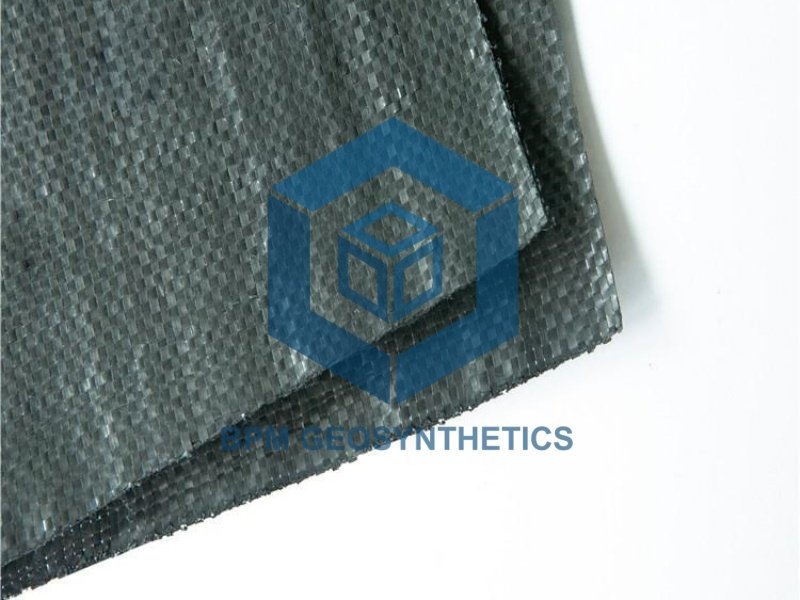
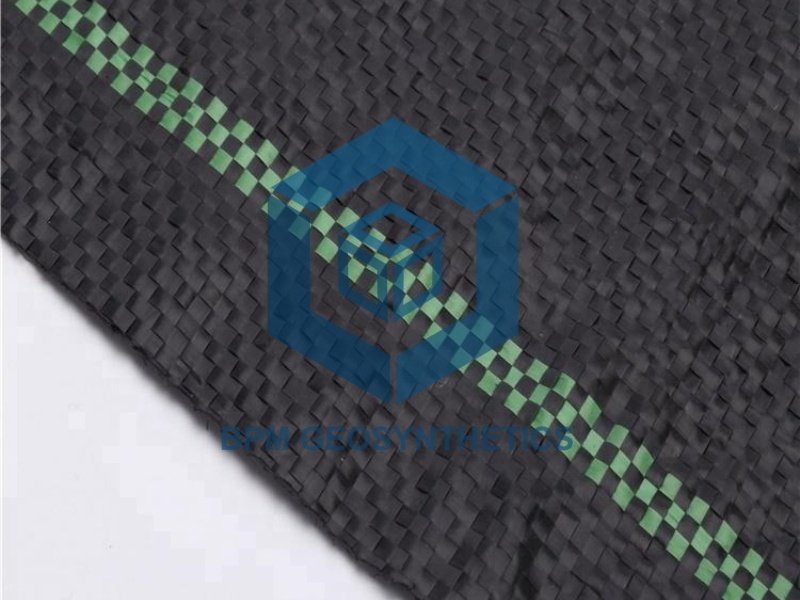
Woven geotextile fabric belongs to the broader family of geosynthetic materials—man-made products used to improve soil conditions in construction and environmental projects. It is manufactured by weaving polypropylene yarns or tapes together on specialized looms, creating a dense, uniform grid-like structure. Polypropylene is the material of choice because of its exceptional resistance to chemical degradation, rot, mildew, and soil acids, as well as its high melting point and stability across a wide temperature range.
The weaving process produces a fabric with two defining characteristics: high tensile strength and very low elongation (typically less than 15% at break). This means the fabric can withstand substantial pulling or stretching forces without deforming—a critical property when heavy vehicles impose dynamic loads on the driveway surface. The resulting product resembles a tough, heavy-duty canvas or tarpaulin, though it remains permeable enough to allow water passage.
It is essential to distinguish woven geotextiles from their non-woven counterparts. Non-woven geotextiles are manufactured by bonding synthetic fibers through heat, chemical, or needle-punching processes, resulting in a felt-like, thicker material. While non-woven fabrics excel in filtration, drainage, and cushioning applications, they lack the high tensile strength and load-distribution capabilities of woven fabrics. For driveway stabilization and separation, woven geotextile is the correct and specified choice.
3.The Core Functions: Separation, Stabilization, and Reinforcement
Woven driveway fabric performs three interdependent roles that collectively ensure a robust and durable base.
3.1. Separation
Separation is the most fundamental and vital function. When a driveway is constructed directly over native soil—whether clay, silt, sand, or loam—the sharp, angular edges of crushed stone aggregate are continually pressed downward by vehicle weight. Simultaneously, moisture and freeze-thaw cycles cause the underlying soil to become soft and plastic. Without an intervening barrier, the aggregate progressively penetrates and intermixes with the subgrade soil.
This phenomenon, known as “pumping” or “migration,” creates a contaminated layer that loses its load-bearing capacity. The result is a rutted, uneven surface that requires frequent patching or resurfacing.
Woven geotextile acts as a permanent physical separator. Its tight weave blocks the upward movement of fine soil particles while preventing the downward intrusion of coarse aggregate. The two layers remain distinct and functional, preserving the structural integrity of the base course.
3.2. Stabilization through Load Distribution
Stabilization is the second critical role. Woven geotextile possesses remarkable tensile strength, often ranging from 200 to over 600 pounds per inch of width depending on the grade. When placed at the interface between the subgrade and the aggregate, this fabric engages with the stone above it. Under traffic loads, the fabric’s yarns become tensioned, creating a “membrane effect” that spreads the concentrated wheel load over a significantly wider area of the underlying soil.
This distribution reduces the peak pressure exerted on the subgrade, effectively allowing a weaker or softer soil to support heavier loads than it could otherwise handle. In engineering terms, the fabric increases the “bearing capacity” of the foundation. For a residential driveway, this means even occasional heavy vehicles—delivery trucks, RVs, or construction equipment—cause less deformation and settlement.
3.3. Reinforcement
For more demanding applications, such as steep driveways, areas with extremely soft subgrades (e.g., high clay content or high water tables), or commercial parking lots subject to frequent heavy traffic, the reinforcement function becomes paramount. Heavier woven geotextiles—such as those with tensile strengths of 600 lbs/in or more—provide active reinforcement by absorbing shear stresses and restricting lateral movement of the aggregate. This lateral confinement keeps the stone base tightly interlocked, preventing the sideways spreading that often precedes deep rutting.
4.Detailed Benefits over Alternatives
Using woven geotextile fabric offers a suite of practical, financial, and environmental advantages that make it superior to traditional construction methods.
4.1Extended Service Life: Studies and field experience consistently show that driveways incorporating woven geotextile last 3 to 5 times longer than those built directly on soil. The elimination of aggregate-soil mixing preserves the designed thickness and load capacity of the base indefinitely.
4.2Reduced Aggregate Thickness: Because the fabric improves load distribution, engineers can often reduce the required thickness of the gravel base by 20% to 40% compared to unreinforced designs. This translates directly into lower material costs, less excavation, and reduced hauling expenses.
4.3Lower Long-Term Maintenance Costs: Homeowners and facility managers frequently report that after installing woven geotextile, they no longer need to add fresh gravel annually or fill potholes after every rainy season. Maintenance becomes limited to occasional grading of the surface layer, saving both money and labor over decades.
4.4Improved Drainage and Frost Resistance: Although woven fabrics are primarily separation and reinforcement tools, their open-weave structure does allow water to drain vertically through the aggregate and into the subgrade. This prevents the formation of perched water tables within the base, reducing the risk of frost heave in cold climates. When water freezes within the base, it expands and disrupts the stone structure; proper drainage minimizes this hazard.
4.5Environmental Sustainability: By extending driveway life and reducing the frequency of re-graveling or reconstruction, woven geotextile lowers the overall consumption of virgin aggregates and the carbon footprint associated with quarrying, transportation, and construction equipment. It is a sustainable choice in the truest sense.
5.Weight and Strength Classifications
Grade / Weight | Typical Tensile Strength (lbs/in) | Best Application |
Lightweight (3 oz/sq yd) | 200 | Very firm soils, light passenger car traffic only, temporary driveways. |
Medium-Weight (4–5 oz) | 300–400 | Standard residential driveways with passenger vehicles and occasional light trucks. |
Heavyweight (6 oz) | 500–600 | Frequent heavy trucks, RVs, steep slopes, or soft clay/silty subgrades. |
Extra-Heavy (8–10 oz) | 600+ | Commercial lots, industrial access roads, very weak organic or wetland soils. |
For most single-family residential driveways, a 4-ounce to 6-ounce woven fabric with a tensile strength of at least 300 lbs/in is appropriate. If the subgrade is noticeably soft or wet when excavated, upgrading to a 6-ounce or heavier product is a prudent investment.
6.Installation: A Step-by-Step Guide
Proper installation is as critical as the fabric itself. Even the highest-grade geotextile will fail if improperly placed.
6.1.Excavation: Remove all topsoil, vegetation, roots, and large rocks to the planned depth. The subgrade should be relatively smooth and free of sharp objects that could puncture the fabric during compaction.
6.2.Subgrade Compaction: Lightly compact the native soil with a vibratory plate compactor or roller. This provides a firm, even foundation for the fabric.
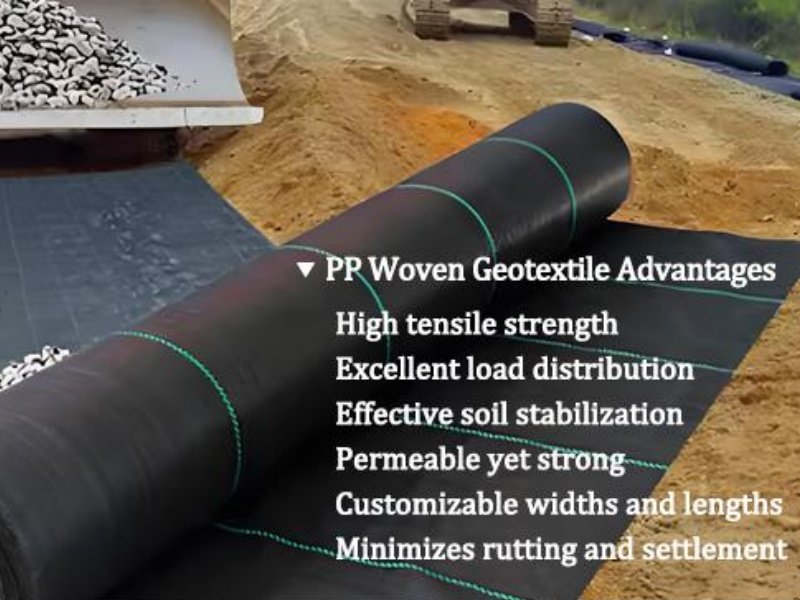
6.3Fabric Deployment: Roll the woven geotextile directly over the prepared subgrade. Overlap adjacent rolls by at least 12 to 18 inches (more on soft soils). For the best performance, the roll direction should be perpendicular to the primary traffic direction.
6.4Securing: Temporarily anchor the fabric with landscape staples, pins, or small piles of stone to prevent wind movement during stone placement.
6.5Aggregate Placement: Dump and spread the crushed stone (typically ¾-inch to 1½-inch angular aggregate) over the fabric to a minimum depth of 4 inches for passenger cars, and 6 to 8 inches for heavier loads.
6.6Critical rule: The first lift of stone must be placed without driving vehicles directly on the exposed fabric, as wheel spin can tear or displace it. Dump the stone from the edge and push it forward with a dozer or excavator.
6.7Compaction: Compact the stone in layers (lifts) using a vibratory roller or plate compactor until a firm, interlocked surface is achieved. Finish with a top course of finer gravel or, if paved, proceed with asphalt or concrete placement.
7.Conclusion
Woven geotextile fabric is not merely a landscaping accessory; it is an engineered structural component that fundamentally transforms the performance of a driveway. By performing the essential functions of separation, stabilization, and reinforcement, it prevents the two primary failure modes—aggregate loss into the subgrade and base deformation under load. It reduces construction costs, slashes long-term maintenance, improves drainage, and extends driveway life from a few years to multiple decades. For any property owner planning a new driveway or rehabilitating an existing one, selecting the appropriate woven geotextile and installing it correctly is the single most impactful decision they can make. It is, quite simply, the foundation of a lasting driveway.