Soil erosion severely threatens the stability of engineering projects, and traditional concrete protection is gradually being replaced by more ecological solutions. BPM Geosynthetics‘ 3D geomat, a highly efficient “soft engineering” material, mimics plant root structures, providing immediate protection for vegetation growth.
This system not only significantly enhances slope resistance to erosion but also promotes biodiversity restoration. With its excellent cost-effectiveness and ease of construction, BPM Geosynthetics helps engineers achieve long-term slope stability while simultaneously realizing the dual goals of landscaping and sustainable development.
1. What is Geomat?
1.1 Geomat Introduction
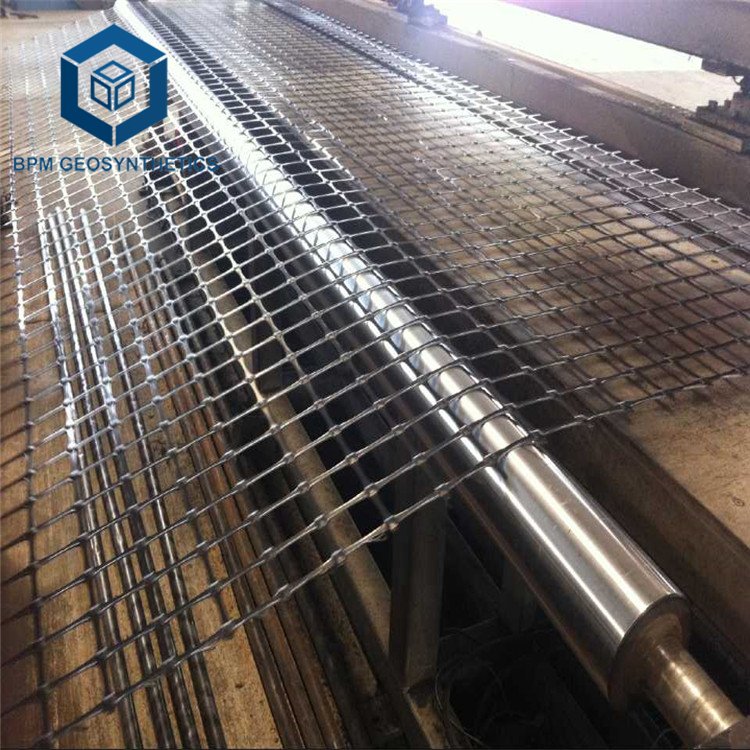
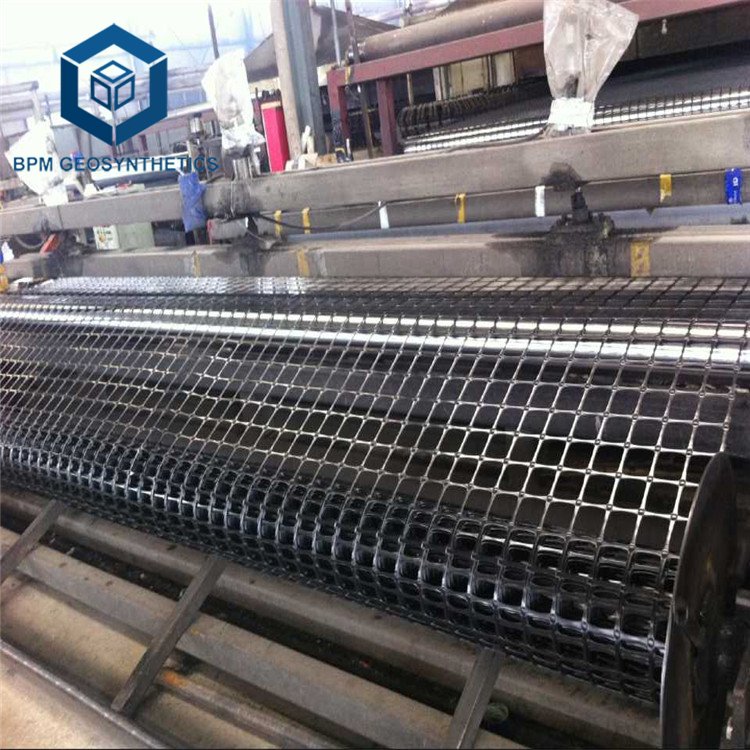
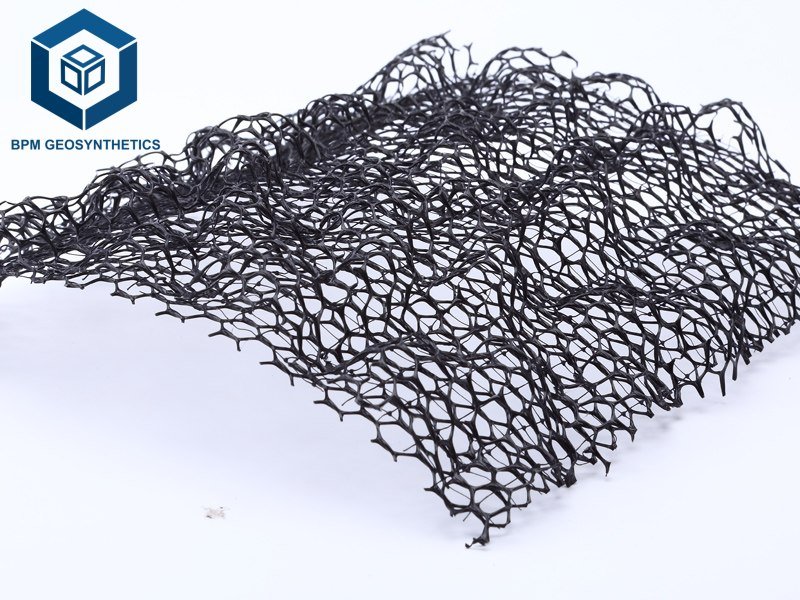
A Geomat (also known as a Three-Dimensional Erosion Control Geomat) is a permeable, synthetic, three-dimensional structure made from UV-stabilized polymer materials. It is designed specifically to protect soil surfaces from erosion caused by wind and water while promoting the rapid growth of vegetation.
1.2 Geomat Key Characteristics
Three-Dimensional Structure: Unlike a flat erosion blanket, a geomat has a thick, voluminous mesh (resembling a tangled scouring pad) that provides space for soil and root integration.
Material Composition: Usually made from High-Density Polyethylene (HDPE) or Polypropylene (PP) to ensure chemical resistance and long-term durability.
High Porosity: Typically over 90% open space, allowing water to infiltrate and roots to pass through easily.
UV Resistance: Contains carbon black or UV inhibitors to prevent the plastic from becoming brittle under sunlight.
Physical Reinforcement of the Root System
2. How does a geomat physically reinforce the root system of vegetation to prevent soil erosion?
2.1 The “Anchor and Interlock” Mechanism
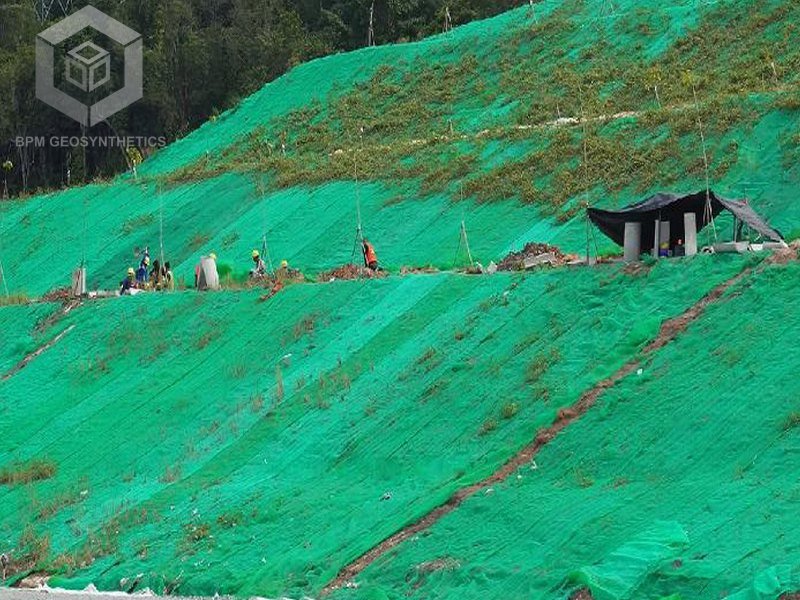
A geomat acts as a three-dimensional matrix that physically entwines with plant biology. In the early stages, the open mesh traps seeds and soil in place. As the seeds germinate, the roots grow through the geomat’s voids, literally “locking” the synthetic fibers into the soil profile.
1.2 Structural Composite Formation
Once fully vegetated, the geomat and the root system form a unified root-mat composite. This composite layer acts like a reinforced skin on the slope, increasing the soil’s “apparent cohesion.” This prevents surface sloughing and protects the soil from being washed away during heavy rainfall.
Hydraulic Limits: Flow Velocity and Shear Stress
3. What is the maximum flow velocity or shear stress that a high-quality geomat can withstand on a steep slope?
3.1 Maximum Flow Velocity Thresholds
High-quality 3D geomats are designed to withstand significant hydraulic forces.
Unvegetated: Typically, a bare geomat can handle flow velocities of 1.5 to 2.0 m/s.
Vegetated: Once plants are established, the threshold jumps to 4.0 to 6.0 m/s**, depending on the mat’s thickness and density.
3.2 Shear Stress Resistance
Shear stress refers to the “dragging” force of water over the surface. A premium geomat can resist shear stresses of up to 250–500 Pa (Pascals) when fully vegetated. This makes them suitable for channel linings and spillways where water moves with high energy.
Contribution to “Green Engineering”
4. How does using geomats contribute to “Green Engineering” compared to traditional concrete lining?
Ecological Restoration vs. Concrete Sterility
Unlike concrete lining, which creates a “biological desert,” geomats facilitate a living landscape. They allow for the restoration of natural habitats, encouraging local flora and fauna to return to the project site.
Carbon Footprint and Permeability
- Reduced Carbon: The manufacturing and transport of lightweight geomats produce significantly lower CO2emissions than the production and hauling of heavy cement and aggregate.
- Natural Hydrology: Concrete creates impermeable surfaces that increase downstream flooding; geomats maintain the natural water cycle by allowing the ground to breathe and absorb water.
5. What are the UV-stabilization properties that ensure the geomat doesn’t degrade before vegetation is fully established?
5.1 Carbon Black Incorporation
Since geomats are often exposed to direct sunlight before vegetation covers them, they are treated with Carbon Black (typically 2-3%). This additive absorbs ultraviolet radiation and converts it into heat, preventing the polymer chains from breaking down.
5.2 Oxidative Induction Time (OIT)
Manufacturers like BPM Geosynthetics test for OIT to ensure the material maintains its mechanical properties for 10 to 25 years. This longevity ensures the geomat provides a “safety net” even if the vegetation undergoes a dry season or temporary die-back.
6. Will the Effect of Geomat Be Affected Under Different Climatic Conditions?
Geomat performance is inherently linked to environmental exposure. While designed for durability, its efficacy and longevity can be significantly influenced by specific climatic stressors.
6.1 Impact of Drought and Arid Conditions
Vegetation Establishment Challenge: The primary function of Geomat is to facilitate plant growth, whose roots provide permanent reinforcement. Drought severely impedes seed germination and seedling survival, delaying or preventing the development of this critical vegetative layer.
Material Degradation: Prolonged exposure to intense UV radiation and extreme heat, common in arid climates, can accelerate the oxidative degradation of certain polymer materials (like some polypropylenes) used in Geomat, potentially reducing its tensile strength over time.
Design Adaptation: Successful application in these regions often requires selecting UV-stabilized geomats, integrating drought-resistant plant species, and possibly temporary irrigation systems to ensure establishment.
6.2 Impact of rainstorm and storm events
Performance during construction: Extreme rainfall will result in higher surface runoff velocity. The three-dimensional structure of Geomat can provide immediate physical protection by dissipating flow energy, capturing soil particles, and preventing surface sealing or rill formation.
Long term synergistic effect with vegetation: After vegetation is established, Geomat strengthens the root matrix, making the system very elastic and jointly bearing high hydraulic pressure.
The risk of improper installation: The main risk in heavy rain is not material failure, but installation errors (such as insufficient anchoring or poor soil contact), which may result in underwater cutting or displacement.
6.3. Effects of freeze-thaw cycles
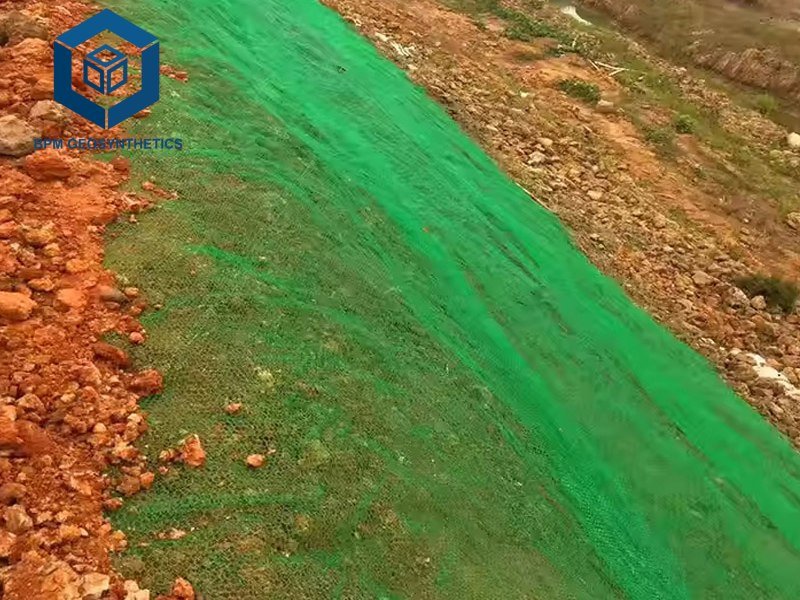
Soil dynamics: Repeated freeze-thaw cycles can cause soil expansion and contraction, leading to reduced freeze-thaw and thawing. This may disrupt the tight contact between Geomat and soil matrix, creating gaps or causing anchor points to loosen.
Material brittleness: Under sustained freezing temperatures, some Geomat materials may temporarily become more brittle, which may make them more susceptible to damage from sharp ice crystals or thick coatings in a frozen state.
Durability considerations: This climate causes the highest mechanical stress. Geomats made of flexible, high toughness polymers such as certain polyamides or polyesters with robust anchoring designs are crucial. Their open structure must allow soil movement without losing overall integrity.
Summary
In the field of erosion control, BPM Geosynthetics‘ 3D geomat represent an efficient and eco-friendly engineering solution. It forms a solid composite with vegetation roots through its unique three-dimensional structure, significantly enhancing its resistance to shear and erosion, and achieving an organic combination of engineering stability and natural ecological restoration. This material not only has excellent UV resistance and durability, but also can adapt to drought, rainstorm, freezing and thawing and other climatic conditions, showing excellent environmental toughness. If you have any convenient questions, please contact BPM Geosynthetics. BPM geosynthetics has over ten years of export experience and can provide you with suitable geomat models. Choosing BPM Geosynthetics’ geomat means achieving the dual goals of sustainable engineering and ecology with lower carbon footprint and cost-effectiveness throughout the entire lifecycle.